
- Our Article
Fleet Preventive Maintenance in India: How Telematics Helps Reduce Vehicle Downtime
For a commercial fleet, a vehicle breakdown is rarely just a maintenance problem.A truck that unexpectedly goes off the road can delay deliveries, disrupt routes, affect driver productivity, create emergency repair costs, and force operations teams to find replacement vehicles at short notice.For Indian fleets operating across long routes, construction sites, distribution networks, industrial locations, or remote areas, keeping vehicles available for daily operations is therefore critical.
This is why fleet preventive maintenance needs to move beyond spreadsheets, manual odometer checks, and service reminders that depend entirely on people remembering the next maintenance date.
Modern telematics can provide fleet managers with vehicle usage, mileage, engine hours, operational behaviour, maintenance alerts, and—where supported—vehicle health and diagnostic information.
The objective is simple:
identify maintenance requirements earlier, plan servicing more accurately, and reduce avoidable vehicle downtime.
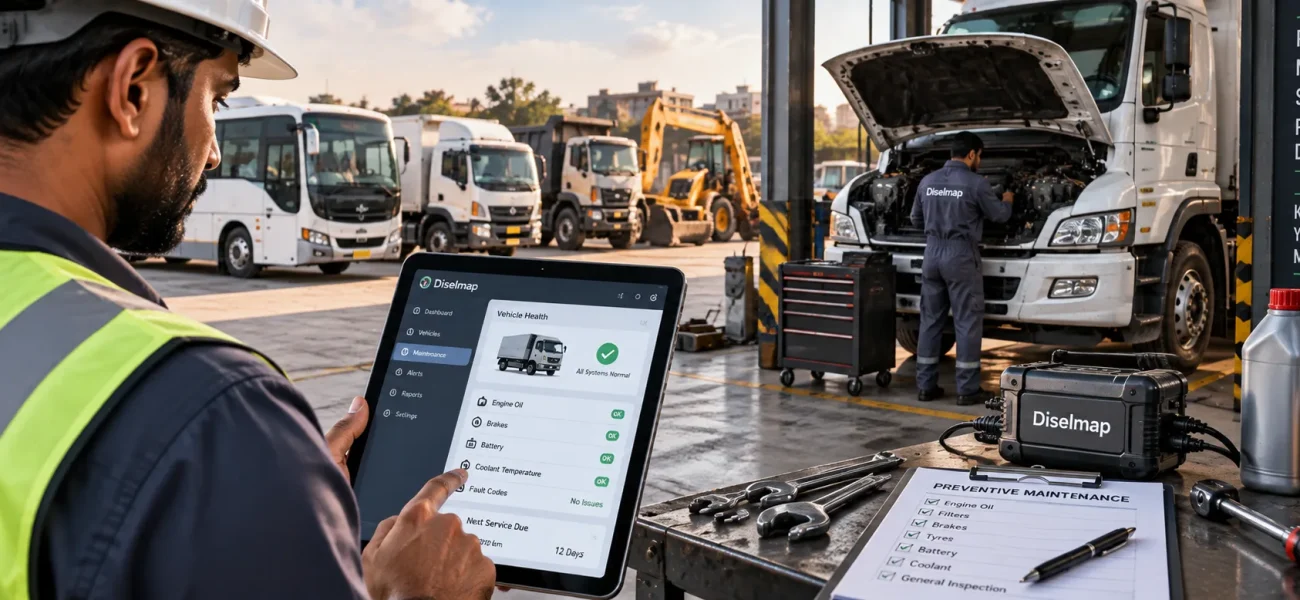
What Is Fleet Preventive Maintenance?
Fleet preventive maintenance is the planned inspection, servicing, and maintenance of vehicles before unexpected failures occur.
Instead of waiting for a vehicle to break down, fleet managers follow defined maintenance intervals and vehicle-condition information to keep assets in reliable operating condition.
Preventive maintenance may include:
- Engine oil and filter changes
- Brake inspections
- Tyre inspections
- Battery checks
- Cooling-system inspection
- Fluid checks
- Belt and hose inspection
- Scheduled lubrication
- Vehicle safety inspections
- Manufacturer-recommended servicing
- Replacement of wear components
- Inspection of recurring vehicle faults
The exact maintenance schedule depends on the vehicle type, manufacturer recommendations, operating conditions, mileage, engine hours, load, and fleet usage.
For fleet managers, the challenge is not simply knowing that maintenance is important.
The bigger challenge is knowing which vehicle needs attention, when it needs attention, and how to schedule maintenance without unnecessarily disrupting operations.
Preventive vs Reactive vs Predictive Fleet Maintenance
These terms are related but should not be treated as identical.
Reactive Maintenance
Reactive maintenance happens after a fault or failure has already occurred.
A vehicle breaks down, develops a serious problem, or becomes unavailable, and the fleet then responds.
Some reactive maintenance will always be necessary, but relying heavily on this approach can result in unpredictable downtime and emergency repair activity.
Preventive Maintenance
Preventive maintenance follows planned intervals based on factors such as:
- Time
- Kilometres travelled
- Engine operating hours
- Manufacturer service schedules
- Inspection results
The goal is to service the vehicle before avoidable failure occurs.
Predictive or Condition-Based Maintenance
Predictive maintenance goes further by using available vehicle-condition information and performance trends to identify signs that a component or system may require attention.
Telematics, connected diagnostics, sensors, and CAN Bus information can support this approach where appropriate data is available.
For most fleets, the practical maintenance strategy is not choosing only one method.
It is combining scheduled preventive maintenance with available vehicle-health information and operational data.
Why Vehicle Downtime Is a Major Fleet Management Problem
Vehicle downtime means a fleet asset is unavailable when the business needs it.
Some downtime is planned and necessary, such as scheduled servicing.
The bigger problem is unplanned downtime.
An unexpected breakdown can affect much more than the repair workshop.
It may result in:
- Delayed deliveries
- Missed trips
- Vehicle reassignment
- Driver waiting time
- Emergency towing
- Additional repair expenses
- Customer communication issues
- Lower vehicle utilization
- Disrupted route planning
- Reduced fleet capacity
The operational cost of a breakdown can therefore extend beyond the cost of replacing a failed component.
For fleet managers, reducing downtime requires identifying maintenance requirements earlier and making servicing part of normal fleet planning rather than an emergency response.
Why Traditional Maintenance Tracking Can Become Difficult
Managing a few vehicles manually may be straightforward.
The problem becomes more complicated as a fleet grows.
Missed Service Intervals
If service schedules depend on spreadsheets, registers, or manual reminders, maintenance may be delayed when information is not updated on time.
Inaccurate Mileage Information
A maintenance team may need to contact drivers or physically inspect odometers to understand how far each vehicle has travelled.
For fleets operating across different locations, keeping those readings updated can become difficult.
Engine Hours Are Often Overlooked
Mileage alone does not always represent vehicle usage accurately.
Construction machinery, mining equipment, generators, and vehicles that spend significant time idling may accumulate substantial engine operating time without travelling long distances.
Limited Visibility Between Workshop Visits
A vehicle may appear normal during its last service but develop an operational issue before the next scheduled workshop visit.
Without connected vehicle information, maintenance teams may depend heavily on driver reporting.
Maintenance Records Become Fragmented
Service dates, repair history, odometer readings, breakdown records, and vehicle information may exist across different files and departments.
This makes it harder to understand recurring vehicle problems.
Telematics can help close some of these information gaps.
How Telematics Helps Reduce Vehicle Downtime
Fleet telematics connects vehicle activity with software that fleet managers can use to monitor operations.
Depending on the telematics system, connected hardware, and vehicle integration, available information may include:
- GPS location
- Distance travelled
- Engine hours
- Ignition information
- Idling
- Vehicle utilization
- Driver behaviour
- Maintenance reminders
- Vehicle status
- Diagnostic information
- CAN Bus parameters
- Vehicle health alerts
Not every vehicle exposes the same information, so availability should always be confirmed for the particular vehicle and telematics integration.
The real maintenance benefit comes from using this information to make servicing more timely and more structured.
1. Maintenance Based on Actual Vehicle Mileage
Preventive servicing is often scheduled after a vehicle reaches a specified distance.
Telematics can continuously capture vehicle usage, reducing dependence on manual odometer updates.
For example, if a vehicle is approaching its maintenance interval, the fleet team can receive advance visibility and schedule the service.
This makes it easier to avoid situations where a vehicle continues operating significantly beyond its planned service interval simply because nobody updated the mileage.
2. Engine-Hour-Based Maintenance
Kilometres travelled do not tell the full story for every fleet asset.
Consider:
- Excavators
- Loaders
- Mining equipment
- Construction machinery
- Vehicles with extensive idling
- Equipment operating mainly within sites
These assets may run their engines for many hours while covering comparatively little distance.
Where engine-hour information is available, fleet managers can use it alongside mileage to plan maintenance more accurately.
This is particularly valuable for construction and equipment fleets.
3. Service Reminders and Maintenance Alerts
Fleet telematics can help automate maintenance reminders based on defined conditions.
Instead of manually reviewing every vehicle each week, fleet managers can identify vehicles approaching service requirements.
Possible reminders may include:
Service approaching
Service due
Service overdue
Inspection required
This helps maintenance teams prioritize work across larger fleets.
4. Vehicle Health and Diagnostic Information
Where supported by the vehicle and integration, connected diagnostics can provide additional information about vehicle condition.
This may include:
- Diagnostic trouble codes
- Engine temperature
- Battery voltage
- Engine operating information
- Selected CAN Bus parameters
- Other vehicle-specific alerts
This information can give maintenance teams additional context when deciding whether a vehicle requires inspection.
A diagnostic alert does not replace professional mechanical diagnosis.
Its value is providing earlier visibility that something may require attention.
5. Detecting Overheating and Abnormal Conditions
Some vehicle problems develop gradually before becoming serious enough to stop the vehicle.
Where temperature or other vehicle-health information is available, fleet managers may be able to identify abnormal operating conditions earlier.
For example:
Repeated high-temperature event
↓
Vehicle flagged for review
↓
Maintenance team investigates
↓
Issue addressed during planned maintenance
This is preferable to discovering the same issue only after a roadside breakdown.
6. Monitoring Excessive Idling
Idling is usually discussed as a fuel-management problem, but it can also affect vehicle operating hours and maintenance planning.
A vehicle that spends significant time idling may accumulate operating hours much faster than its kilometre reading suggests.
Monitoring idling therefore gives fleet managers additional context when evaluating:
- Actual engine usage
- Fuel consumption
- Maintenance intervals
- Driver behaviour
- Vehicle utilization
7. Understanding Driver Behaviour
How vehicles are driven can influence wear and operating condition.
Telematics can help identify driving events such as:
- Harsh acceleration
- Harsh braking
- Excessive speeding
- Prolonged idling
- Other supported driver events
Fleet managers should not assume every maintenance problem is caused by driver behaviour.
However, combining maintenance history with driver and vehicle operating data can reveal patterns worth investigating.
For example, if one vehicle repeatedly experiences abnormal wear while also showing aggressive operating patterns, managers have more context for further investigation.
What Maintenance Data Should Fleet Managers Monitor?
Not every available data point needs to appear on the maintenance dashboard.
Focus on information that supports an actual decision.
| Maintenance Data | Why It Matters |
|---|---|
| Vehicle mileage | Helps trigger distance-based service |
| Engine hours | Helps measure actual operating time |
| Service due date | Supports scheduled maintenance |
| Last service | Provides maintenance history |
| Overdue maintenance | Identifies compliance gaps |
| Vehicle downtime | Measures asset availability |
| Breakdown history | Helps identify recurring problems |
| Diagnostic alerts | Supports earlier investigation |
| Engine temperature | Helps identify abnormal operating conditions |
| Battery information | Supports electrical-system monitoring where available |
| Idling | Adds context to engine usage |
| Driver behaviour | Helps analyse vehicle operating patterns |
| Repair history | Identifies high-maintenance vehicles |
| Maintenance cost | Helps compare vehicle lifecycle performance |
The purpose is not to create another dashboard full of numbers.
Each metric should help answer a fleet-management question.
A Practical Telematics-Based Maintenance Workflow
Telematics becomes useful when information leads to action.
A simple preventive-maintenance workflow can look like this:
Step 1: Monitor Vehicle Usage
Track kilometres, engine hours, operating time, and other relevant vehicle information.
Step 2: Set Maintenance Intervals
Define maintenance requirements according to manufacturer recommendations and your fleet’s operating conditions.
Step 3: Generate Advance Alerts
Identify vehicles approaching their next scheduled service instead of waiting until they become overdue.
Step 4: Review Vehicle Health Information
Where supported, review diagnostic alerts, temperatures, CAN Bus information, and recurring operational exceptions.
Step 5: Prioritize Vehicles
Separate:
Routine upcoming maintenance
from
Vehicles requiring urgent inspection
Step 6: Schedule Maintenance Around Operations
Plan workshop time when the vehicle can be taken out of service with minimal disruption to routes and customer commitments.
Step 7: Record Completed Maintenance
Maintain accurate service history for each vehicle.
Step 8: Review Recurring Problems
If the same vehicle repeatedly experiences similar faults or high repair costs, investigate the pattern rather than treating every repair as an independent event.
This transforms maintenance from a list of reminders into a structured operational process.
How Telematics Helps Different Types of Indian Fleets
Maintenance requirements vary significantly between industries.
Logistics and Transportation Fleets
Long-distance trucks accumulate kilometres quickly and can operate far from their home depot.
Telematics helps managers monitor vehicle usage, maintenance intervals, routes, and available vehicle-health information without waiting for trucks to return to base.
Construction and Mining Fleets
Construction vehicles and heavy equipment may accumulate engine hours faster than road mileage.
Engine-hour monitoring, idling information, equipment utilization, and vehicle-health data can therefore be particularly useful for planning maintenance.
Manufacturing and Distribution Fleets
Delivery and distribution fleets often operate on tight schedules.
Unexpected vehicle downtime can disrupt dispatch planning and customer deliveries.
Advance maintenance visibility allows operations teams to plan vehicle availability more effectively.
Oil and Gas Fleets
Vehicles operating in demanding or remote environments can be difficult to recover when unexpected failures occur.
Maintenance planning combined with real-time vehicle visibility can help teams identify vehicles requiring attention before they are assigned to critical operations.
Fleet Rental and Leasing
Rental and leasing operators need visibility across vehicles that may be used differently by different customers or drivers.
Mileage, utilization, service history, and maintenance status help operators manage service requirements consistently across distributed assets.
Preventive Maintenance and CAN Bus Data
CAN Bus information can provide another layer of vehicle visibility.
Where the commercial vehicle and telematics hardware support the required integration, available CAN data may include parameters such as:
- Engine RPM
- Engine hours
- Coolant temperature
- Fuel-related information
- Battery voltage
- Vehicle speed
- Diagnostic trouble codes
- Other supported vehicle parameters
This information can supplement GPS and maintenance records.
For example:
GPS tells you where the vehicle is.
Telematics tells you how it is being used.
CAN Bus data can provide deeper information about what is happening within supported vehicle systems.
Combining these sources can give maintenance teams better operational context.
Preventive Maintenance KPIs Fleet Managers Should Track
A preventive-maintenance program should be measured.
Useful KPIs include:
Vehicle Uptime
How much of the required operating time is the vehicle available for work?
Unplanned Downtime
How much time is lost because of unexpected breakdowns or unscheduled repairs?
Preventive Maintenance Compliance
What percentage of planned services are completed on time?
Overdue Services
How many vehicles have exceeded their scheduled maintenance intervals?
Breakdown Frequency
Which vehicles experience repeated unplanned failures?
Maintenance Cost per Vehicle
Which assets require consistently high repair and maintenance spending?
Mean Time Between Failures
For fleets with sufficient maintenance data, tracking how frequently failures occur can help identify reliability trends.
The goal is not simply to reduce maintenance spending.
Sometimes spending on the right preventive maintenance at the right time can avoid much greater operational disruption later.
Common Preventive Maintenance Mistakes to Avoid
Technology alone will not create a reliable maintenance program.
Avoid these common mistakes.
Using the Same Maintenance Logic for Every Vehicle
Vehicle type, operating conditions, load, route, age, and manufacturer requirements can differ significantly.
Relying Only on Calendar Dates
Vehicles do not all accumulate usage at the same rate.
Mileage and engine-hour information can provide better context.
Ignoring Driver Reports
Telematics should complement driver inspections and feedback, not replace them.
Drivers often notice vibration, noise, braking changes, steering problems, and other physical symptoms before they appear clearly in digital data.
Treating Every Diagnostic Alert as a Confirmed Failure
An alert or fault code is an indication for investigation.
Qualified technicians should determine the actual cause and required repair.
Collecting Data Without a Maintenance Workflow
A dashboard cannot reduce downtime by itself.
Someone must be responsible for reviewing alerts, scheduling maintenance, recording completed work, and following up on recurring problems.
Telematics Does Not Replace Vehicle Inspections
This distinction is important.
Telematics can improve maintenance visibility, but it does not replace:
- Physical vehicle inspections
- Driver pre-trip checks
- Workshop diagnosis
- Manufacturer service requirements
- Qualified technicians
- Tyre inspections
- Brake inspections
- Fluid checks
- Safety inspections
The strongest maintenance process combines vehicle data + preventive schedules + physical inspections + maintenance expertise.
Technology improves the timing and quality of information available to the people making maintenance decisions.
How Diselmap Supports Data-Driven Fleet Maintenance
Diselmap helps businesses connect fleet information through technologies such as GPS tracking, telematics, CAN Bus integration, driver monitoring, fuel monitoring, and real-time fleet visibility.
For preventive maintenance, connected fleet information can help managers understand vehicle usage, monitor relevant operating data, identify maintenance requirements, and plan service activities more effectively.
Instead of managing maintenance as an isolated workshop activity, fleets can connect it with broader operational information.
A fleet manager can consider:
Vehicle mileage
→ Engine hours
→ Vehicle utilization
→ Idling
→ Driver behaviour
→ Vehicle-health information
→ Maintenance history
→ Operational requirements
This provides better context for deciding which vehicle needs maintenance and when it should be scheduled.
The exact information available depends on the vehicle, connected hardware, and implementation.
FAQ About Fleet Preventive Maintenance
What is fleet preventive maintenance?
Fleet preventive maintenance is the planned inspection and servicing of commercial vehicles before unexpected failures occur. Maintenance may be scheduled according to time, mileage, engine hours, manufacturer recommendations, inspections, and available vehicle-condition information.
How does telematics help with preventive maintenance?
Telematics can provide vehicle mileage, engine hours, utilization, idling, maintenance reminders, and—where supported—diagnostic and vehicle-health information. Fleet managers can use this data to identify upcoming service requirements and plan maintenance more accurately.
Can telematics reduce vehicle breakdowns?
Telematics can help fleets identify maintenance requirements and certain abnormal vehicle conditions earlier, allowing teams to investigate and service vehicles before some issues develop into larger failures. It cannot prevent every breakdown.
What is the difference between preventive and predictive maintenance?
Preventive maintenance is generally performed according to planned service intervals. Predictive maintenance uses condition and performance information to help determine when a vehicle or component may require attention.
Is mileage enough for scheduling fleet maintenance?
Not always. Mileage is useful for road vehicles, but engine hours may provide better context for vehicles and equipment that spend significant time operating while stationary or travelling short distances.
Can CAN Bus data be used for fleet maintenance?
Yes, where compatible vehicle data is available. CAN Bus integration may provide parameters such as engine hours, temperature, RPM, diagnostic information, and other supported signals that can add useful context to maintenance decisions.
Does preventive maintenance eliminate vehicle downtime?
No. Vehicles still require planned servicing and unexpected failures can occur. The goal of preventive maintenance is to reduce avoidable unplanned downtime and make necessary maintenance more predictable.
Conclusion
Fleet preventive maintenance is not simply about servicing vehicles more frequently.
It is about servicing the right vehicle at the right time using accurate information.
For Indian commercial fleets, telematics can improve this process by providing better visibility into vehicle usage, mileage, engine hours, idling, maintenance intervals, and supported vehicle-health information.
When telematics data is combined with maintenance history, physical inspections, driver feedback, and professional workshop diagnosis, fleet managers can move from reactive repairs toward more structured maintenance planning.
The goal is not to eliminate every repair.
It is to identify problems earlier, reduce avoidable breakdowns, improve vehicle availability, and keep fleet operations moving with fewer unexpected interruptions.
Reduce Downtime with Smarter Fleet Maintenance
Unexpected breakdowns can disrupt routes, deliveries, and daily fleet operations.
Diselmap helps businesses connect telematics, GPS tracking, vehicle data, and fleet insights to support more informed preventive-maintenance decisions and better vehicle availability.
Want to improve maintenance visibility across your fleet?