
- Our Article
AI Driver Monitoring for Commercial Fleets in India
AI-powered driver monitoring is becoming increasingly relevant to Indian commercial fleets as operators look beyond basic vehicle tracking toward drowsiness detection, driver-risk analysis, video context and connected safety data. A major 3,000-truck deployment announced in 2026 shows how these technologies are moving into large-scale fleet operations while India also prepares for new driver-drowsiness safety requirements.
Quick Answer
AI driver monitoring uses cameras, vehicle information and software analytics to identify selected driver-safety conditions such as drowsiness, distraction or repeated risky behaviour.
In April 2026, Roadzen announced an approximately $2.5 million deployment of its drivebuddyAI system across 3,000 heavy-duty trucks in India, with potential expansion as the customer’s fleet grows. The announced capabilities include drowsiness detection, driver identification, cabin monitoring, safety scoring and command-centre communication. Roadzen Inc
At the same time, India’s regulatory framework now requires Driver Drowsiness and Attention Warning Systems conforming to AIS-184 for specified M2, M3, N2 and N3 vehicles manufactured from defined dates in 2027 and 2028. Ministry of Road Transport and Highways
For fleet managers, however, driver monitoring is not only about compliance.
Its practical value comes from connecting driver events, GPS location, telematics and video context so safety teams can identify recurring risks, verify what happened and support more targeted driver coaching.
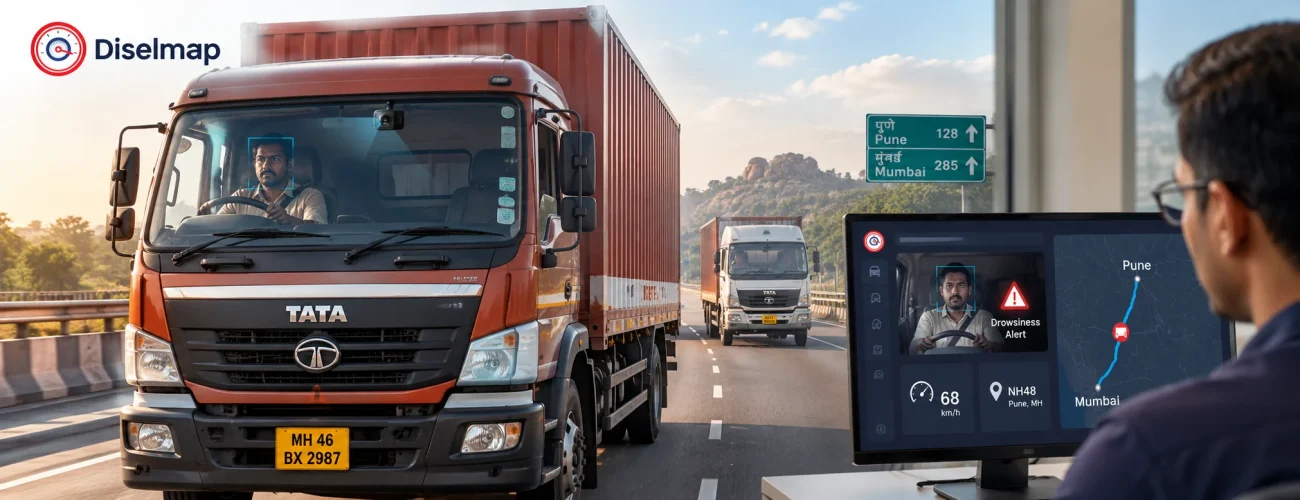
A 3,000-Truck Deployment Shows How Fleet Safety Is Changing
On April 29, 2026, Roadzen announced that its drivebuddyAI platform had secured a contract covering a six-camera ADAS deployment across 3,000 heavy-duty trucks operated by an Indian fleet company.
Roadzen said the contract represented approximately $2.5 million in initial contracted revenue and could expand as the operator’s fleet grows, potentially reaching 10,000 vehicles over five years. Roadzen Inc
The scale of the rollout is significant.
But the more useful lesson for fleet operators is what the system is being asked to monitor.
According to the announcement, the deployment focuses on:
- Driver drowsiness detection
- Driver identification and vehicle-driver mapping
- Cabin occupancy monitoring
- Driver safety and technical-skills scoring
- Two-way command-centre communication
These capabilities show how commercial fleet safety is moving beyond simple location monitoring.
Traditional GPS primarily answers:
Where is the vehicle?
A connected driver-safety system can help answer additional questions:
Who is driving?
Is a safety risk developing?
What was the vehicle doing when the event occurred?
Does the same pattern keep happening?
That additional context can make safety data more actionable.
Why This Matters for Indian Commercial Fleets
Large fleets operate across very different environments.
A truck may spend one day travelling on a national highway and another moving through congested urban roads, industrial locations or loading yards.
Fleet managers also need to manage:
- Delivery schedules
- Driver availability
- Vehicle utilisation
- Fuel costs
- Maintenance
- Road safety
- Customer commitments
As fleet size increases, manually observing how every driver operates becomes impossible.
GPS can show where the vehicle travelled.
Telematics can show selected driving events.
A driver-monitoring system may add information about the person behind the wheel.
Combining these data sources gives managers a more complete picture of operational risk.
What Is AI Driver Monitoring?
AI driver monitoring uses compatible cameras, vehicle data and analytics software to identify selected driver conditions or behaviours.
The exact capability depends on the installed technology.
Some systems focus mainly on the cabin.
Others combine information from:
- Driver-facing cameras
- Road-facing cameras
- GPS
- Vehicle speed
- Telematics
- Sensors
- Trip history
- Driver identification
This distinction is important.
A standard GPS device does not automatically provide drowsiness or distraction detection.
Those functions require technology designed specifically for that purpose.
Driver Monitoring vs Driver Behaviour Monitoring
These terms are related, but they should not be treated as identical.
Driver Monitoring
Driver monitoring generally focuses directly on the person operating the vehicle.
Depending on the system, it may identify indicators associated with:
- Drowsiness
- Distraction
- Driver presence
- Head or eye movement
- Driver identity
- Selected in-cabin conditions
Driver Behaviour Monitoring
Driver behaviour monitoring focuses more broadly on how the vehicle is being operated.
A Driver Behaviour Monitoring solution may use GPS and telematics information to analyse events such as:
- Speeding
- Harsh braking
- Rapid acceleration
- Harsh cornering
- Excessive idling
- Repeated driving patterns
The two approaches can complement each other.
For example:
A camera identifies possible distraction.
Telematics records sudden braking.
GPS identifies the location.
Video provides additional context.
That produces a more useful event record than any single signal alone.
Driver Drowsiness Detection
Fatigue is particularly relevant to long-distance commercial transport.
Extended driving periods, night operations and repetitive highway conditions can affect alertness.
Compatible driver-monitoring systems can analyse selected indicators associated with drowsiness and generate warnings when configured thresholds are reached.
Roadzen specifically identified real-time drowsiness detection as one of the capabilities included in its 3,000-truck deployment. Roadzen Inc
Technology, however, should not replace proper fatigue management.
Fleet operators still need to consider:
- Driving hours
- Rest periods
- Shift design
- Route duration
- Night operations
- Driver welfare
A warning identifies a potential problem.
The fleet still needs a process for responding to it.
Why Driver Identification Matters
Commercial drivers may change vehicles, shifts, routes or depots.
If a fleet cannot reliably associate an event with the correct driver, behaviour analysis becomes less useful.
Consider this example:
Vehicle 152 recorded four harsh-braking events.
That identifies an asset-level issue.
But if the same driver records similar events across several vehicles, the fleet may identify a broader coaching opportunity.
Driver-to-vehicle mapping can therefore help managers move from:
vehicle event analysis
toward:
driver-level safety analysis.
Cabin Monitoring Adds Another Layer of Context
The Roadzen deployment also includes cabin occupancy monitoring. Roadzen Inc
The exact capabilities of in-cabin systems vary considerably.
Fleet operators should therefore verify precisely what a system monitors before purchasing it.
Depending on the technology, cabin information may provide context that GPS or basic telematics cannot.
But more information is not automatically better.
The most useful data is information that supports a clear safety decision.
Driver Scores Should Identify Patterns, Not Just Events
One isolated event rarely tells the complete story.
For example:
A driver may record one harsh-braking event because another vehicle suddenly entered the lane.
That is very different from a driver showing repeated combinations of:
speeding + harsh braking + aggressive acceleration
across many trips.
This is where driver scorecards and historical reports can become useful.
The objective should be to identify:
- Repeated behaviours
- Changes over time
- Drivers requiring coaching
- Routes associated with recurring events
- Whether coaching produces improvement
A driver score should therefore be used as a starting point for investigation, not as an automatic conclusion about driver performance.
AIS-184 and India’s Driver-Drowsiness Requirements
Driver-monitoring technology is also becoming more important because of changes in India’s commercial-vehicle safety regulations.
Government notification G.S.R. 834(E) inserted Rule 125Q into the Central Motor Vehicles Rules.
It states that vehicles in categories M2, M3, N2 and N3 manufactured on or after October 1, 2027 for new models and January 1, 2028 for existing models must be fitted with Driver Drowsiness and Attention Warning Systems conforming to AIS-184 until corresponding BIS specifications are notified. Ministry of Road Transport and Highways
This wording is important.
Does AIS-184 Mean Every Existing Truck Must Be Retrofitted?
No blanket retrofit requirement for every truck already operating on Indian roads is stated in this notification.
The rule specifically refers to vehicles manufactured on or after the applicable dates, distinguishing between new vehicle models and existing vehicle models. Ministry of Road Transport and Highways
Fleet operators should therefore avoid interpreting “existing models” as meaning every currently registered vehicle automatically requires retrofit from January 2028.
The regulatory wording is focused on vehicles manufactured after the specified implementation dates.
What Does AIS-184 Cover?
AIS-184 covers Driver Drowsiness and Attention Warning Systems.
The standard includes requirements for monitoring drowsiness and issuing warnings to the driver.
ARAI’s published AIS-184 document states that the system should monitor driver drowsiness and provide a warning when the defined level is reached. It also allows the system to analyse vehicle-related indicators such as steering behaviour and lateral lane position when determining possible drowsy driving. HMR Portal
This is broader than simply installing a camera.
The actual technical approach can involve different indicators, provided the system satisfies the relevant requirements.
Compliance Is Not the Same as Fleet Safety
Regulatory compliance is important.
But a compliant device alone does not create a complete safety programme.
Fleet safety depends on several elements working together:
Technology + Driver Training + Fleet Policy + Operational Response
Suppose a system identifies a possible drowsiness event.
The fleet still needs to decide:
- Who receives the alert?
- Should the driver stop?
- Is this a repeated pattern?
- Is the shift schedule contributing?
- Has the driver had adequate rest?
- Does the route repeatedly create fatigue problems?
- What happens after the event?
Technology identifies information.
Fleet management determines the response.
GPS Adds Trip Context to Driver Events
AI driver monitoring does not replace GPS tracking.
A GPS Tracking System can provide important journey context around a driver-safety event.
For example, after a drowsiness alert, a manager may want to know:
- Where did it happen?
- How long had the vehicle been travelling?
- Was the truck on a highway or inside a depot?
- What time did the trip begin?
- Did the vehicle stop after the alert?
- Has the same route produced similar events?
This makes the safety event easier to interpret.
Telematics Adds Vehicle Context
A Telematics Solution can add information about how the vehicle was operating at the time.
Depending on hardware compatibility, useful information may include:
- Vehicle speed
- Ignition status
- Engine hours
- Idle time
- Trip activity
- Selected driving events
- Diagnostic information
This helps the fleet move from:
“An alert occurred.”
to:
“What was the vehicle doing when the alert occurred?”
Video Can Explain What Vehicle Data Cannot
Telematics may show severe braking.
But it cannot always explain why the driver braked.
Possible causes include:
- Sudden traffic
- A pedestrian
- Another vehicle cutting into the lane
- Poor following distance
- Driver distraction
- A road hazard
A compatible Dashcam & 360° Camera solution can provide visual context around selected incidents.
Video can therefore complement GPS and telematics when reviewing:
- Harsh braking
- Near misses
- Collisions
- Driver complaints
- Road incidents
- Insurance-related events
The strongest approach is not camera or telematics.
It is using the appropriate data sources together.
Why Every Important Alert Should Be Verified
One of the biggest mistakes in fleet safety is assuming:
alert = driver fault
That is not always true.
Harsh braking may be a correct response to a dangerous situation.
Speed variation may be caused by traffic.
A driver-fatigue issue may also indicate poor shift planning or insufficient rest opportunities.
For important events, use a simple process:
Detect → Verify → Understand → Coach → Measure → Improve
This prevents fleet teams from treating every notification as proof of wrongdoing.
It also makes driver coaching more credible.
Turn Driver Data Into Better Coaching
Driver-monitoring technology creates the most value when it helps improve behaviour over time.
Instead of giving every driver the same generic safety message, managers can use actual event patterns.
For example:
Driver A
One harsh-braking event during an entire month.
No recurring speeding or other pattern.
Driver B
Repeated speeding and harsh-driving events across several trips.
These drivers probably do not require the same intervention.
A better coaching process focuses on:
- Recurring behaviour
- Event context
- Route conditions
- Driver history
- Improvement after coaching
This turns monitoring into a safety-management process rather than simply an alert system.
How Fleet Operators Can Implement Driver Monitoring
1. Establish a Baseline
Before installing new technology, understand the current situation.
Track relevant indicators such as:
- Safety incidents
- Driving events
- Driver complaints
- Fuel consumption
- Vehicle damage
- Maintenance trends
Without a baseline, it becomes difficult to determine whether the programme has improved anything.
2. Define the Actual Safety Problem
Do not select a system simply because it uses AI.
First determine what the fleet needs to improve.
Examples include:
- Drowsiness
- Distraction
- Speeding
- Harsh driving
- Driver identification
- Incident evidence
- Driver coaching
3. Select the Appropriate Technology
Not every fleet needs the same configuration.
Some operations may need:
GPS + telematics
Others may require:
GPS + telematics + compatible cameras
The correct combination depends on the operating environment and identified risks.
4. Configure Meaningful Alerts
Too many notifications create alert fatigue.
Fleet managers should separate:
events requiring immediate intervention
from:
events better reviewed as historical trends.
5. Verify Important Events
Use GPS, telematics and available video context before drawing conclusions.
6. Coach Based on Patterns
Focus coaching on repeated behaviours rather than isolated incidents.
7. Measure Improvement
After coaching or operational changes, check whether the same risk pattern decreases.
That is how monitoring becomes a continuous improvement process.
What to Check Before Choosing a Driver Monitoring System
Monitoring Capability
Does the system actually monitor the risk your fleet is trying to manage?
Do not assume every AI platform offers the same functions.
Alert Accuracy
High numbers of false alerts can frustrate drivers and overwhelm fleet teams.
Vehicle Compatibility
Check whether the required equipment works across the vehicles in your fleet.
Driver Identification
For multi-driver fleets, determine whether events can be reliably associated with the correct driver.
GPS and Telematics Integration
Driver alerts become more useful when they are connected with location and vehicle information.
Video Availability
Determine whether relevant footage can be retrieved when an incident requires investigation.
Reporting and Trends
A good system should help managers identify repeated patterns rather than showing only isolated notifications.
Driver Communication
Drivers should understand:
- What is monitored
- Why it is monitored
- How data will be used
- How coaching decisions are made
Data Governance
Businesses should establish appropriate policies covering access, retention and use of driver-related data.
Where Driver Monitoring Can Be Useful
Long-Haul Trucking
Long driving periods and night operations can make fatigue and drowsiness particularly important.
Hazardous-Cargo Transport
Tankers and hazardous-material fleets may benefit from stronger driver, route and incident visibility because the consequences of an accident can be significant.
Construction and Mining Fleets
Heavy vehicles, industrial environments and difficult operating conditions create different safety risks.
Bus and Passenger Fleets
Monitoring driver attention and safety events can provide additional operational visibility where passenger safety is involved.
Urban Distribution
Dense traffic, pedestrians, frequent stops and two-wheelers create a different type of risk environment where event and video context may be valuable.
Large-Scale Adoption Is Not Limited to One Deployment
The April 2026 truck contract was followed in June by another Roadzen announcement covering its AI safety technology across up to 3,600 electric buses and trucks operating in public transportation, seaport logistics, mining and industrial transportation in India. Roadzen Inc
That does not prove universal effectiveness.
But it does provide another example of large commercial fleets investing in connected driver-safety systems.
What the 3,000-Truck Announcement Does Not Prove
The Roadzen announcement is useful evidence of commercial deployment.
It should not be treated as independent scientific proof that every fleet installing similar technology will achieve a specific reduction in accidents, fuel consumption or operating costs.
Roadzen makes its own performance claims about the platform, but the announcement is a company-issued release and includes forward-looking qualifications. Roadzen Inc
For that reason, fleet managers should measure results within their own operations.
A sensible evaluation might compare:
Before deployment
with:
After deployment
using the same safety indicators over a meaningful period.
This is more reliable than assuming one company’s results will automatically apply to another fleet.
How Diselmap Supports Driver Safety Visibility
Driver safety becomes more useful when events are connected with the wider fleet operation.
Diselmap helps businesses combine driver behaviour monitoring, GPS tracking, telematics, trip information and compatible video solutions to provide better visibility into how vehicles and drivers operate.
Depending on the selected equipment and configuration, fleet teams can use connected information to:
- Review speeding and selected driving events
- Identify repeated behaviour patterns
- Analyse trip and location context
- Review harsh-driving activity
- Monitor driver performance trends
- Support targeted coaching
- Investigate incidents using available fleet data
Exact capabilities depend on the hardware, integration and solution selected.
Diselmap should therefore be used as part of a wider fleet-safety process rather than treating technology alone as a complete solution.
For a broader approach to driver and vehicle risk, explore Fleet Safety Management.
Frequently Asked Questions
What is AI driver monitoring?
AI driver monitoring uses compatible cameras, vehicle information and software analytics to identify selected driver conditions or safety-related behaviours. Depending on the system, this may include drowsiness, distraction, driver identification or other monitored events.
Can AI detect driver drowsiness?
Compatible systems can analyse selected indicators associated with drowsiness and provide warnings when defined conditions are detected. Technology should still be supported by appropriate rest periods, working-hour policies and fatigue management.
What is AIS-184?
AIS-184 is India’s automotive standard covering Driver Drowsiness and Attention Warning Systems. It specifies requirements for monitoring possible driver drowsiness and providing warnings. HMR Portal
When do AIS-184 requirements apply in India?
Does AIS-184 mean every existing truck must be retrofitted?
The notification does not state that every vehicle already operating on Indian roads must automatically be retrofitted. It applies to vehicles manufactured on or after the specified dates and distinguishes between new and existing vehicle models. Ministry of Road Transport and Highways
What is the difference between driver monitoring and driver behaviour monitoring?
Driver monitoring usually focuses directly on the driver, such as drowsiness or distraction. Driver behaviour monitoring generally analyses how the vehicle is operated, including speeding, harsh braking, acceleration and other driving events.
Can normal GPS tracking detect driver drowsiness?
No. Standard GPS tracking provides location and trip information. Drowsiness detection requires compatible monitoring technology designed for that purpose.
Why combine GPS, telematics and video for fleet safety?
GPS provides location, telematics provides vehicle and driving context, and video can help explain what happened around an event. Combining these data sources can support more informed incident investigation and driver coaching.
From Vehicle Tracking to Risk Visibility
Commercial fleet technology has traditionally focused on one important question:
Where is my vehicle?
That question still matters.
But modern safety systems increasingly add another:
What risk may be developing around this driver and vehicle?
The 3,000-truck deployment shows that large Indian fleet operators are beginning to use AI-assisted safety technology at commercial scale.
India’s AIS-184 framework also confirms that driver drowsiness and attention-warning systems are becoming part of the country’s formal commercial-vehicle safety direction.
The strongest approach is therefore not:
Install technology → Generate more alerts
It is:
Detect → Verify → Understand → Coach → Measure → Improve
Resources & References
Roadzen – 3,000-Truck AI Safety Deployment
Official company announcement covering the large-scale deployment of AI-powered driver monitoring and ADAS technology across 3,000 heavy-duty trucks in India.
https://investors.roadzen.io/news-releases/news-release-details/roadzens-drivebuddyai-wins-25-million-contract-bring-ai-poweredMinistry of Road Transport & Highways – G.S.R. 834(E)
Official government notification covering Driver Drowsiness and Attention Warning System requirements for specified M2, M3, N2 and N3 vehicle categories.
https://morth.nic.in/sites/default/files/notifications_document/GSR%20834%28E%29%20dated%2011th%20November.pdfARAI – AIS-184 Standard
Technical standard outlining requirements for Driver Drowsiness and Attention Warning Systems used in applicable commercial vehicle categories in India.
https://hmr.araiindia.com/api/AISFiles/AIS-184_6b499ef6-b60a-49c3-bedd-1c0fc571b856.pdf
Build Better Driver Safety Visibility with Diselmap
Safe fleet operations require more than isolated alerts.Diselmap helps fleet operators connect driver behaviour information, GPS tracking, telematics and compatible video monitoring to understand recurring risk patterns and make better safety decisions.
Use connected fleet data to improve visibility, support evidence-based driver coaching and strengthen day-to-day fleet safety management.