
- Our Article
Diesel Consumption Monitoring for
Construction Fleets in India
Construction fleets in India operate in demanding conditions where diesel is a major operating cost. Excavators, loaders, tippers, cranes, generators and other equipment often work long hours across multiple sites.
For fleet managers, tracking diesel purchases is not enough. The key question is: How much fuel is each vehicle or machine actually consuming?
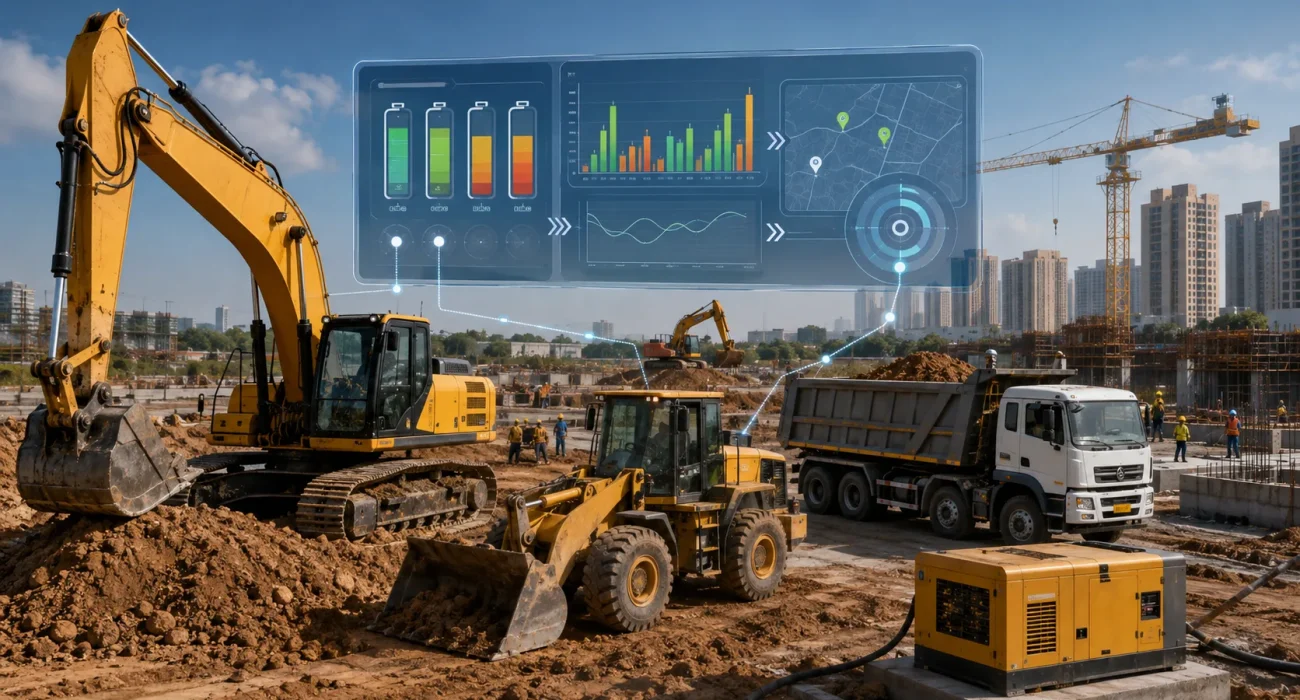
Manual records, fuel slips and tank readings can make accurate monitoring difficult. Diesel consumption monitoring for construction fleets helps businesses track fuel levels, consumption patterns and equipment activity using fuel sensors, GPS, telematics and fleet management software.
This gives fleet managers better visibility, accountability and control over fuel costs.
Why Diesel Consumption Monitoring Matters for Construction Fleets
Fuel management is particularly challenging for construction companies because equipment does not always operate from a central depot.
A construction business may have vehicles and machinery working simultaneously across highways, infrastructure projects, industrial sites, commercial developments, mining areas and remote project locations.
Some assets may be:
Owned by the company
Hired or rented from third parties
Stationary at a project site
Moving between multiple locations
Operating for long periods
Consuming significant quantities of diesel
As the number of assets and project locations increases, manual fuel monitoring becomes increasingly difficult to manage.
Common challenges include:
Difficulty verifying actual diesel consumption
Delayed fuel reporting
Inconsistent manual tank readings
Excessive equipment idling
Unexpected changes in fuel levels
Fuel usage that does not match equipment activity
Limited visibility across remote project sites
Difficulty comparing similar machines
Challenges monitoring hired equipment
Lack of centralized historical fuel data
A digital construction fleet fuel monitoring system can provide a more consistent way to monitor fuel activity across vehicles and heavy equipment.
The Fuel Visibility Challenge on Indian Construction Sites
Construction companies may operate several projects at the same time. An excavator could be working at one site, tippers may be transporting materials from another location, and generators may be supporting operations at a third site.
When fuel information is collected manually, management may know how much diesel was purchased without having a clear picture of how that fuel was consumed.
For example, a fleet manager may need to know:
What was the fuel level before refuelling?
How much diesel was added?
What was the fuel level afterward?
How much fuel was consumed during the operating period?
Where was the equipment when the fuel level changed?
Was the equipment operating or stationary?
Is the consumption consistent with its operating conditions?
How does its consumption compare with similar equipment?
Connecting fuel information with equipment, location and operational data can help close this visibility gap.
How Diesel Consumption Monitoring Works
A modern diesel monitoring system can combine several technologies to provide a clearer picture of fuel usage.
A fuel level sensor measures changes in the equipment’s fuel tank. Depending on the system configuration, this information can be transmitted to a centralized fleet monitoring platform.
When fuel monitoring is combined with GPS and telematics, fleet managers can review fuel activity alongside location and operational information.
The data flow can be broadly understood as:
Fuel Level → Vehicle or Equipment → Location → Time → Operating Activity → Consumption Pattern
This allows businesses to move beyond basic manual records and analyze fuel activity using digital information.
Depending on the equipment, sensor configuration and fleet platform, a monitoring system may provide visibility into:
Current fuel level
Fuel consumption
Refuelling activity
Fuel-level changes
Equipment location
Operating periods
Historical fuel trends
Unusual consumption patterns
Which Construction Equipment Can Be Monitored?
Construction fleets can include a wide range of diesel-powered vehicles and machinery.
Suitable assets may include:
Excavators
Wheel loaders
Backhoe loaders
Tippers
Dump trucks
Transit mixers
Cranes
Generators
Tractors
Heavy commercial vehicles
Other diesel-powered construction equipment
Each asset type has different tank capacities, workloads and operating conditions. Therefore, fuel consumption should be evaluated according to the specific asset and its working environment rather than applying the same benchmark to every machine.
10 Ways Diesel Consumption Monitoring Can Improve Construction Fleet Operations
1. Monitor Fuel Levels Across Construction Equipment
Fuel-level monitoring can provide fleet managers with better visibility into the fuel status of connected vehicles and equipment.
Instead of depending entirely on physical inspections or manual tank readings, managers can review fuel information through a centralized platform.
This is particularly useful when equipment is distributed across multiple project sites and cannot be checked continuously.
2. Track Diesel Consumption More Accurately
Knowing how much diesel was purchased does not necessarily explain how much fuel each asset consumed.
Construction companies can use fuel data to understand consumption by vehicle, machine and operating period.
For example, an excavator’s fuel usage can be reviewed alongside its operating hours. A tipper’s consumption can be considered together with its movement and trip activity.
This helps fleet managers answer a more useful question:
How much diesel is each asset consuming during actual operations?
3. Identify Unusual Fuel-Level Changes
Unexpected fuel-level changes can indicate an event that requires investigation.
Examples include:
Sudden fuel-level drops
Unexpected fuel increases
Fuel changes while equipment is parked
Consumption during non-working periods
Repeated abnormal fuel events
Differences between reported and measured fuel levels
An unusual fuel event does not automatically indicate a specific cause. Operational conditions, measurement issues or other factors may also explain the change.
The benefit of monitoring is that it gives fleet managers timely information to investigate.
4. Improve Fuel Accountability for Hired Equipment
Many construction companies operate a combination of owned and hired equipment.
When machinery is rented from a third party, verifying fuel usage can become more difficult if the company relies only on manual records.
Digital fuel monitoring can provide additional information for comparing:
Reported Fuel Usage + Measured Fuel-Level Data + Equipment Activity
This can improve transparency when reviewing fuel expenses associated with hired excavators, loaders, generators and other machinery.
5. Connect Fuel Data With GPS Location
Fuel data becomes more useful when combined with location information.
Fleet managers can investigate:
Where the equipment was located
When the fuel level changed
Whether the asset was moving or stationary
Whether the equipment was operating
Where a refuelling event occurred
Whether the fuel activity matched the expected operation
For road-going construction vehicles, GPS data can also provide context around routes, trips and vehicle movement.
Together, these data points provide a more complete operational picture than fuel information alone.
6. Identify Excessive Fuel Consumption
Not all high fuel consumption has the same cause.
Excessive idling, inefficient operating practices, heavy workloads, poor route planning, equipment condition and unnecessary operating hours can all contribute to higher fuel usage.
Historical fuel data can help fleet managers identify assets or operating patterns that appear unusual.
For example, if two similar machines perform comparable work but one consistently consumes more fuel, the difference can be investigated.
Possible factors may include workload, operating conditions, equipment condition, idling or other operational variables.
7. Monitor Fuel Usage Across Multiple Project Sites
Large construction companies may have vehicles and machinery operating across several projects simultaneously.
A centralized construction fleet fuel monitoring system can help management review fuel information across multiple assets and locations.
This makes it easier to compare:
Fuel usage by vehicle
Fuel usage by equipment
Fuel usage by project
Consumption trends
Operating patterns
Unusual fuel events
Instead of maintaining separate fuel records for every project, businesses can work toward a more centralized view of fleet fuel activity.
8. Create Better Digital Fuel Records
Manual fuel records become increasingly difficult to manage as the number of assets grows.
Digital monitoring can organize information such as:
Fuel level
Diesel consumption
Refuelling activity
Vehicle or equipment identity
Location
Date and time
Operating activity
Historical fuel trends
This information can support reporting, investigation and long-term fuel-cost analysis.
9. Compare Fuel Performance Between Similar Assets
Construction companies often operate multiple machines of the same or similar type.
Historical fuel information can help managers identify differences between comparable assets.
For example:
Machine A: Consistent consumption pattern
Machine B: Higher-than-expected consumption
Machine C: Irregular fuel-level changes
These differences do not automatically mean an asset has a problem.
However, they can help fleet managers identify which vehicles or machines may require further investigation, maintenance or operational review.
10. Reduce Dependence on Manual Fuel Monitoring
Manual fuel management may involve operators, drivers, supervisors, site managers and fuel suppliers.
When several people contribute information, delays and discrepancies can become difficult to identify.
A connected monitoring system provides a common digital source of fuel and operational information.
The goal is not necessarily to eliminate every manual process. Instead, digital fuel data can make existing processes easier to verify, manage and analyze.
Diesel Monitoring for Owned and Hired Construction Equipment
Construction fleets often include a combination of:
Owned Equipment + Hired Equipment + Transport Vehicles + Site Machinery
Each category can have different fuel-management requirements.
For owned equipment, historical fuel data can help businesses understand long-term consumption patterns.
For hired equipment, independent fuel information can provide additional visibility when reviewing reported usage.
For transport vehicles, fuel data can be reviewed alongside GPS movement and trip activity.
For stationary generators and site machinery, fuel-level monitoring can provide visibility even when the asset is not travelling.
This makes digital fuel monitoring useful across different types of construction assets.
Diesel Consumption Monitoring vs Manual Fuel Tracking
| Manual Fuel Tracking | Digital Diesel Monitoring |
|---|---|
| Relies heavily on manual entries | Uses connected equipment data |
| Information may be delayed | Provides timely fuel visibility |
| Difficult to monitor remote assets | Centralized monitoring across connected assets |
| Limited historical analysis | Historical fuel trends can be reviewed |
| Difficult to compare assets | Easier comparison between similar equipment |
| Discrepancies may be noticed late | Unusual changes can be investigated sooner |
| Difficult to scale across large fleets | Can support multiple assets and locations |
The objective is not simply to replace manual processes. It is to add a reliable digital layer that helps businesses verify fuel activity and make better operational decisions.
Key Diesel Consumption KPIs for Construction Fleets
Monitoring fuel levels alone is not enough. Fleet managers can also track fuel-related performance indicators to understand how assets are performing over time.
Useful KPIs can include:
Fuel consumption per operating hour
Fuel consumption per trip
Fuel usage by vehicle
Fuel usage by equipment
Fuel usage by project
Refuelling frequency
Fuel-level variance
Idle fuel consumption
Consumption trends over time
Fuel cost per operating period
These metrics should be interpreted according to equipment type, workload, operating environment and project conditions.
How GPS and Fuel Monitoring Work Together
GPS tracking and fuel monitoring provide different types of information.
GPS can show where an asset is and how it is moving, while fuel monitoring can show how its fuel level is changing.
When these data points are connected, fleet managers can gain greater operational context.
For example, a manager can investigate a fuel event using:
Fuel Event → Time → Location → Vehicle or Equipment → Operating Activity
This combination can be particularly useful for construction fleets with assets working across multiple project locations.
A Practical Diesel Monitoring Strategy for Construction Companies
Construction companies do not need to monitor every asset from day one.
A practical approach can begin with equipment where fuel visibility has the greatest potential value.
Step 1: Identify High-Consumption Assets
Start with excavators, loaders, tippers, generators and other equipment with significant diesel usage.
Step 2: Establish a Consumption Baseline
Understand the normal consumption pattern for each equipment type and operating environment.
Step 3: Select Suitable Fuel Monitoring Technology
Choose fuel-level monitoring technology based on the tank type, equipment configuration and operating environment.
Step 4: Connect Fuel Data With Fleet Information
Where appropriate, combine fuel data with GPS tracking, telematics and equipment activity.
Step 5: Monitor Exceptions
Focus on unusual fuel changes, abnormal consumption and significant discrepancies rather than manually checking every event.
Step 6: Review Historical Trends
Use historical data to identify recurring patterns and opportunities to improve fuel efficiency and cost control.
Step 7: Expand Across Project Sites
Once the monitoring process is established, extend it to additional vehicles, equipment and project locations.
Why Fuel Visibility Is Becoming More Important for Construction Fleets
As construction operations become larger and more distributed, managing diesel through manual records alone becomes increasingly challenging.
Fleet managers need reliable information to answer practical questions:
Which equipment is consuming the most diesel?
Is reported fuel usage consistent with actual consumption?
Which project is generating higher fuel costs?
Are hired machines using fuel within expected levels?
Are fuel levels changing while equipment is inactive?
Which assets show unusual consumption patterns?
Can fuel expenses be supported by operational data?
Without reliable information, answering these questions can take significant time.
Connected fuel monitoring can help businesses move toward a more measurable and transparent approach to diesel management.
How Diselmap Supports Construction Fleet Fuel Monitoring
Diselmap combines connected fleet technologies such as fuel monitoring, GPS tracking, telematics and centralized fleet data to help businesses improve visibility across their operations.
For construction fleets, a connected monitoring approach can support:
Fuel-level visibility across connected assets
Diesel consumption monitoring
Fuel event monitoring
GPS-based operational context
Historical fuel reporting
Equipment monitoring
Better accountability for hired equipment
Identification of unusual fuel activity
Centralized fleet information
The objective is simple: help fleet managers gain better information about how diesel is being used across vehicles, machinery and project sites.
Improve Fuel Visibility Across Your Construction Fleet
Want better visibility into diesel consumption across your construction vehicles and equipment?
Talk to Diselmap about a connected fuel monitoring solution that can help you track fuel levels, understand consumption patterns and improve accountability across your fleet and project sites.
Frequently Asked Questions
What is diesel consumption monitoring for construction fleets?
Diesel consumption monitoring is the process of using connected fuel-monitoring technology to track fuel levels and consumption across construction vehicles and equipment. When combined with GPS and telematics, it can provide additional context about where and when fuel is being consumed.
Can fuel monitoring be used for excavators and loaders?
Yes. Suitable fuel monitoring technology can be installed on many types of diesel-powered construction equipment, including excavators, loaders, tippers, generators and other machinery, depending on the equipment and tank configuration.
How can construction companies track diesel consumption?
Construction companies can use fuel-level sensors connected to a centralized monitoring platform. Fuel information can then be reviewed alongside equipment activity, GPS location and historical consumption data.
Can diesel monitoring help identify unusual fuel consumption?
Yes. Fuel monitoring can help identify unexpected fuel-level changes or consumption patterns that require investigation. An unusual event should be evaluated in its operational context rather than automatically attributed to a particular cause.
Can fuel monitoring be used for hired construction equipment?
Yes. Fuel monitoring can provide additional visibility for hired or rented equipment by allowing businesses to compare reported fuel usage with measured fuel-level information and equipment activity.
What is the benefit of combining GPS tracking with fuel monitoring?
GPS tracking provides location and movement information, while fuel monitoring provides fuel-level data. Combining both can help fleet managers understand fuel events in relation to where an asset was located and what it was doing.
What fuel KPIs should construction fleet managers track?
Useful KPIs include fuel consumption per operating hour, fuel usage by asset, fuel usage by project, refuelling frequency, idle fuel consumption, fuel-level variance and historical consumption trends.
How can diesel consumption monitoring improve construction fleet management?
It can help businesses improve fuel visibility, understand equipment consumption, identify unusual patterns, compare asset performance, monitor remote equipment and make better-informed decisions about fuel costs and fleet operations.
Conclusion
For construction fleets in India, diesel management is not only about reducing fuel expenses. It is about understanding how fuel is being used across vehicles, heavy equipment, project sites and hired machinery.
Diesel consumption monitoring for construction fleets can help businesses:
Track fuel levels more consistently
Understand equipment fuel consumption
Improve fuel accountability
Monitor hired equipment
Identify unusual consumption patterns
Connect fuel usage with operational data
Compare fuel performance between assets
Improve fuel-cost control
Whether a company operates a small construction fleet or manages a large multi-site operation across India, better fuel visibility can provide the information needed to make smarter fleet decisions.
With Diselmap, businesses can connect fuel monitoring with GPS tracking, telematics and fleet intelligence to build a more transparent and data-driven approach to construction fleet fuel management.
Take Control of Your Fleet with Diselmap
Improve visibility, reduce operational costs, enhance driver safety, and streamline fleet operations with Diselmap’s intelligent Fleet Management System.