
- Our Article
Barrier-Free Tolling in India: How FASTag & ANPR Will Impact Fleet Operators
India’s highway tolling system is moving toward a model where commercial vehicles can pass through selected tolling points without stopping at a physical barrier.The technology behind this transition is called Multi-Lane Free Flow (MLFF) tolling. It combines existing FASTag-based electronic toll collection with Automatic Number Plate Recognition (ANPR) cameras and other roadside sensors.Instead of slowing down, joining a toll queue and waiting for a boom barrier to open, vehicles can be identified while moving through a gantry-based tolling point. The applicable user fee is then processed electronically.
For fleet operators, the change is about more than faster toll collection. It can affect journey planning, toll-account management, fuel use around toll locations, compliance, trip reconciliation and overall highway operating efficiency.India’s first MLFF installation went live at Choryasi on the Surat–Bharuch section of NH-48 in Gujarat in May 2026. NHAI subsequently introduced the system at additional locations including Mundka–Bakkarwala, Daulatpura, Gharaunda, Manoharpura and Shahjahanpur.
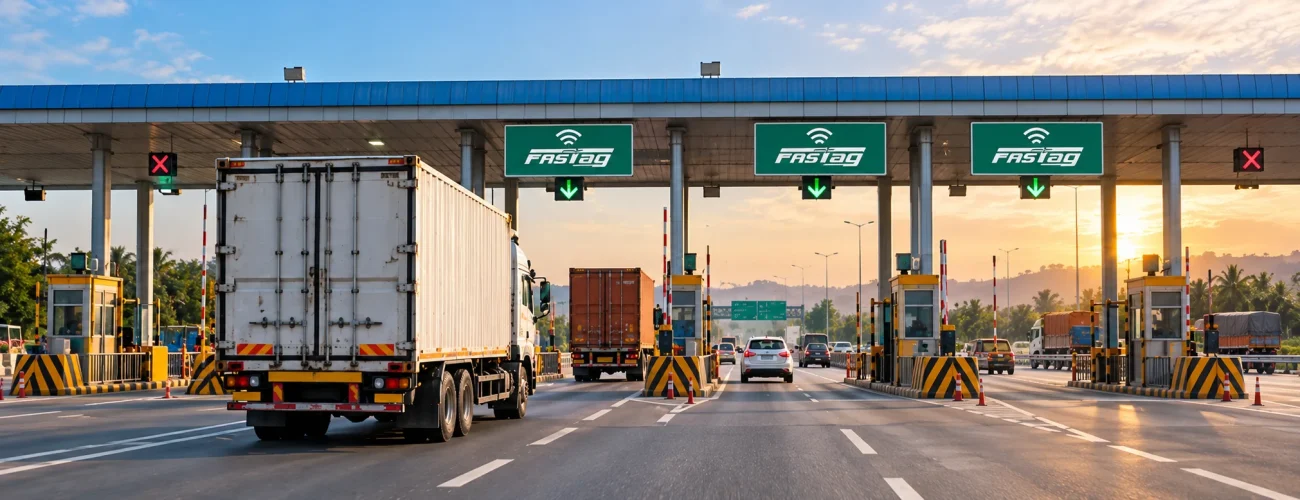
What Is Barrier-Free Tolling in India?
Barrier-free tolling is an electronic toll collection model designed to identify and charge vehicles without requiring them to stop at a conventional toll booth.
NHAI refers to its current implementation as Multi-Lane Free Flow, or MLFF.
At an MLFF location, high-performance cameras, FASTag readers and other equipment are typically mounted on overhead gantries.
As the vehicle passes through, the system identifies it and processes the applicable toll electronically.
According to NHAI, the system combines ANPR technology with FASTag-based Electronic Toll Collection to enable contactless tolling with minimal human intervention.
In simple terms:
Vehicle approaches → FASTag and vehicle number are detected → toll transaction is processed → vehicle continues without a physical barrier
How FASTag and ANPR Work Together
FASTag and ANPR perform different jobs.
FASTag Identifies the Electronic Toll Account
FASTag uses Radio-Frequency Identification, or RFID.
A FASTag attached to the vehicle’s windshield can be detected by compatible readers at the tolling point.
It connects the vehicle with the electronic toll-payment system.
FASTag is already deeply established on India’s National Highways. MoRTH reported in January 2026 that more than 98% of National Highway user-fee collection was taking place through FASTag and that 11.86 crore FASTags had been issued by December 2025.
ANPR Reads the Registration Number
ANPR stands for Automatic Number Plate Recognition.
High-performance cameras capture the registration plate of a passing vehicle and software processes the image to identify the registration number.
This provides another vehicle-identification layer.
The Two Systems Work Together
MLFF combines FASTag/RFID information with the Vehicle Registration Number captured through ANPR.
That gives the tolling system more information than relying on a physical boom barrier alone.
NHAI describes MLFF as a system in which FASTag and vehicle registration numbers are read using high-performance RFID readers and ANPR cameras.
Is Barrier-Free Tolling Already Operating in India?
Yes, but it is important to understand the rollout correctly.
Barrier-free tolling is not simply replacing every Indian toll plaza at once.
The rollout began at selected National Highway locations.
India’s first MLFF system went live at Choryasi Toll Plaza on NH-48 in Gujarat on 1 May 2026. NHAI reported that approximately 41,500 vehicles passed through the location on its first day of operation.
Additional official rollouts during 2026 included:
- Mundka–Bakkarwala on UER-II in NCR
- Daulatpura on the Delhi–Jaipur section of NH-48
- Gharaunda on NH-44
- Manoharpura on NH-48
- Shahjahanpur on NH-48
The August 2026 Shahjahanpur rollout completed barrier-free movement across the identified Manesar-to-Jaipur stretch containing the three MLFF locations at Daulatpura, Manoharpura and Shahjahanpur.
Earlier NHAI plans described implementation as phased, with expansion dependent on performance and effectiveness at selected locations.
Conventional Tolling vs Barrier-Free Tolling
| Area | Conventional Toll Plaza | MLFF Barrier-Free Tolling |
|---|---|---|
| Vehicle movement | May need to slow or stop | Designed for continuous movement |
| Physical barrier | Usually present | No conventional boom barrier |
| Identification | FASTag reader/lane system | FASTag + ANPR + sensors |
| Toll collection | Electronic transaction within toll lane | Electronic transaction while passing gantry |
| Failed payment | Handled within existing plaza process | May result in electronic notice |
| Fleet impact | Queue and toll-stop management | Greater focus on digital transaction and compliance management |
For fleet operators, the most important difference is the shift from managing the toll stop to managing the toll transaction.
How Barrier-Free Tolling Can Affect Commercial Fleets
Commercial fleets cross toll points far more frequently than occasional highway users.
Even small changes at tolling locations can therefore have a larger operational effect across hundreds or thousands of fleet journeys.
Less Toll-Plaza Waiting
A conventional toll plaza can create:
- Queuing
- Braking
- Idling
- Lane changes
- Re-acceleration
MLFF is designed to remove the barrier-related stop.
NHAI says this can improve traffic flow, reduce toll-plaza waiting and improve journey efficiency.
For fleet managers, this may make trip times more predictable on corridors where MLFF has been deployed.
Lower Avoidable Idling Around Toll Points
Heavy vehicles consume fuel while their engines are running even when they are not travelling productively.
Removing toll queues can reduce one source of stationary or stop-and-go operation.
That does not mean a fixed fuel-saving percentage should be assumed.
Actual savings will depend on:
- Vehicle type
- Traffic volume
- Previous queue time
- Engine characteristics
- Route
- Driving conditions
NHAI has identified reduced waiting, fuel consumption and emissions among the intended benefits of MLFF.
For fleets already using a Fuel Management System, toll-related idling can be analysed alongside broader fuel-consumption patterns.
Tolling Can Become Part of Trip Data
Barrier-free tolling also increases the importance of connecting financial transactions with operational data.
Consider a truck travelling from one distribution centre to another.
The fleet may have:
- GPS trip history
- FASTag transactions
- Driver information
- Customer delivery data
- Fuel consumption
- Route details
When these records are reconciled, fleet managers can answer practical questions such as:
- Did this vehicle actually travel through the toll location?
- Was the toll charged on the correct trip?
- Are toll expenses consistent with the assigned route?
- Is the vehicle using the planned highway corridor?
- Are repeated toll transactions appearing unexpectedly?
A connected Fleet Management System can provide the operational context required to review those questions.
GPS Tracking Becomes Useful for Toll Reconciliation
ANPR and FASTag handle the tolling transaction.
GPS serves a different purpose for the fleet.
A GPS Tracking System can show where the commercial vehicle actually travelled.
For example, suppose the operator receives an unexpected toll transaction.
Fleet GPS history may help determine whether that vehicle was:
- Near the toll location
- Travelling on that highway
- Assigned to the corresponding trip
- Somewhere completely different
This does not replace the official toll-dispute process, but it gives the fleet additional operational evidence when investigating unusual transactions.
FASTag Balance Management Becomes More Important
With a conventional toll barrier, payment problems become obvious immediately because a vehicle may be stopped.
In a barrier-free environment, the vehicle may continue travelling while a failed transaction is handled digitally afterward.
NHAI advises users at MLFF locations to maintain sufficient FASTag balance and ensure that the FASTag remains active and functional.
For commercial fleets operating many vehicles, FASTag management should therefore include:
- Monitoring balances
- Checking blocked or inactive tags
- Linking the correct tag to the correct vehicle
- Reviewing transaction history
- Preventing duplicate tags
- Updating records when vehicles are replaced
- Investigating failed toll transactions promptly
FASTag administration becomes part of normal fleet-account management rather than just a driver’s responsibility.
Fleet Operators Need to Pay Attention to E-Notices
This is one of the most important changes for commercial fleets.
India’s National Highways Fee Rules were amended in March 2026 to create a structured recovery mechanism for unpaid user fees, particularly in the context of evolving barrier-free tolling.
An unpaid user fee can arise where ETC infrastructure records a vehicle’s passage but the applicable toll payment is not received.
At operational MLFF locations, NHAI states that scenarios such as an insufficient FASTag balance or an invalid/non-functional FASTag can trigger an electronic notice.
Under the current process described by NHAI:
Payment within 72 hours: normal applicable user fee.
Failure to pay after 72 hours: twice the normal applicable user fee for the vehicle category.
This changes the way fleets should manage toll exceptions.
A missed transaction should not simply sit unnoticed in an accounts queue.
A Practical E-Notice Workflow for Fleets
Fleet operators may want to create an internal process such as:
E-Notice received → identify vehicle → verify trip → check FASTag account → compare GPS history → validate charge → pay or raise grievance within the applicable period
This becomes particularly important for businesses operating:
- Large truck fleets
- Interstate logistics
- Tankers
- Buses
- Construction transport
- Distribution vehicles
- Multi-branch commercial fleets
The more toll passages a fleet generates, the more important exception management becomes.
Number Plate Condition Will Matter More
ANPR depends on being able to read the vehicle registration plate.
NHAI’s MLFF guidance advises road users to maintain clear and compliant High Security Registration Plates (HSRP).
Fleet inspections should therefore include number-plate condition.
Fleet teams should check for:
- Dirt covering characters
- Physical damage
- Incorrect positioning
- Missing plates
- Non-compliant plates
- Obstructions
This is a small maintenance task, but it becomes increasingly important when registration-number recognition is part of electronic tolling.
What Happens If ANPR and FASTag Information Do Not Match?
Fleet managers should avoid assuming that ANPR alone replaces all FASTag administration.
The current MLFF architecture combines registration-number recognition with FASTag-based toll collection.
That means fleet records should stay consistent across:
- Vehicle registration
- FASTag
- Vehicle number
- Fleet asset ID
- Finance records
- Telematics platform
Poor record keeping could make it harder to investigate transaction exceptions later.
Will Barrier-Free Tolling Reduce Fleet Travel Time?
At the tolling location itself, MLFF is designed to remove stopping and conventional toll-lane queuing.
NHAI reports that its MLFF deployments are intended to provide uninterrupted vehicle movement and reduce waiting time.
However, total journey time still depends on many other factors:
- Highway congestion
- Construction
- City traffic
- Weather
- Driver breaks
- Loading delays
- Customer waiting
- Road incidents
Fleet managers should therefore measure actual route performance instead of assuming that barrier-free tolling automatically produces a specific end-to-end time saving.
Impact on Logistics and Delivery Planning
More predictable toll crossings can still help improve planning.
A logistics operator may use telematics to compare:
Before MLFF:
travel time + toll queue + toll transaction + acceleration back to route speed
with:
After MLFF:
continuous highway movement through the tolling point
Across frequent routes, that information can help improve:
- Estimated arrival times
- Dispatch planning
- Driver scheduling
- Route comparisons
- Customer delivery windows
These improvements should be measured using actual fleet data rather than generic savings estimates.
Impact on Fleet Fuel Analysis
Barrier-free tolling also creates an interesting use case for fuel analytics.
If a route previously had recurring toll queues, fleet managers can compare:
- Idle time before MLFF
- Idle time after MLFF
- Fuel consumption
- Average trip duration
- Stop frequency
That helps determine whether the new system is producing a measurable operational benefit for that fleet.
A Fuel Management System or telematics platform can provide additional context instead of relying only on monthly fuel bills.
Impact on Cost-Per-Kilometre Analysis
Toll expenses are part of the operating cost of many commercial fleets.
Fleet managers calculating fleet cost per kilometre may already track:
- Fuel
- Toll charges
- Driver cost
- Maintenance
- Tyres
- Insurance
- Depreciation
Barrier-free tolling does not remove toll costs.
What changes is how those costs are captured and reconciled.
Better digital toll records may make it easier to associate particular toll transactions with specific vehicles, routes and trips.
Will AI Be Used in Barrier-Free Tolling?
Current deployed MLFF systems are officially described primarily in terms of FASTag, ANPR, electronic toll collection, cameras and sensors.
There is also a broader technology direction toward greater use of AI.
In September 2026, the Ministry of Road Transport and Highways said the next goal for barrier-free tolling involves zero stoppage and zero waiting time while leveraging Artificial Intelligence and automatic number-plate recognition.
For accuracy, fleet operators should distinguish between:
Technology already deployed: FASTag + ANPR-based MLFF.
Broader technology direction: increasing use of AI and advanced vehicle-recognition systems.
This distinction avoids treating every current MLFF installation as the same type of AI system.
What Barrier-Free Tolling Does Not Mean
Several misconceptions are worth clearing up.
It Does Not Mean Toll-Free Travel
The toll is still applicable.
Only the collection mechanism changes.
It Does Not Mean FASTag Has Disappeared
FASTag remains central to the current MLFF model.
It Is Not Yet Every Toll Plaza
Rollout has been taking place at selected locations.
It Does Not Remove the Need for Fleet Records
Digital tolling actually makes accurate vehicle, FASTag and registration records more important.
It Does Not Guarantee Zero Delays Across an Entire Journey
It removes the physical toll-barrier stop at an MLFF location. Traffic conditions elsewhere can still cause delays.
How Fleet Managers Should Prepare
Fleet operators do not need to wait until every toll plaza becomes barrier-free.
The following steps can be implemented now.
Audit FASTag Records
Match each FASTag with the correct:
- Vehicle registration
- Fleet ID
- Vehicle category
- Issuer
- Account
Maintain Adequate Balance
Highway vehicles should not depend on last-minute FASTag recharges.
For larger fleets, create automatic or centralized monitoring.
Check FASTag Condition
Ensure tags are:
- Active
- Correctly affixed
- Readable by RFID equipment
- Not duplicated unnecessarily
Inspect Registration Plates
Keep HSRPs clean, visible and compliant.
Monitor E-Notices
Assign responsibility for reviewing electronic toll notices quickly.
Connect Toll Data with GPS History
Use Fleet Telematics to validate routes and trip activity when a toll discrepancy occurs.
Review Toll Costs by Vehicle
Do not treat toll expenses only as one monthly finance total.
Analyse them by:
- Vehicle
- Route
- Driver
- Customer
- Trip
- Depot
Track Toll-Point Idling
Where MLFF is introduced, compare idle and travel-time data before and after implementation.
This turns a national infrastructure change into measurable fleet-performance data.
Barrier-Free Tolling and Connected Fleet Management
The tolling system itself is operated outside the fleet-management platform.
But fleet technology helps operators understand its operational impact.
For example:
FASTag / ANPR tells the toll system:
Which vehicle passed and whether the user fee was collected.
GPS tracking tells the fleet:
Where the vehicle travelled.
Telematics tells the fleet:
How the vehicle operated during the journey.
Fuel monitoring tells the fleet:
How fuel consumption changed.
Fleet management software brings the information together:
Vehicle, route, trip, driver, cost and operating context.
This is why barrier-free tolling should be viewed as another digital data point within a connected fleet operation.
What About FASTag Portability?
Another recent development may also be useful for fleets managing large numbers of tags.
In September 2026, IHMCL and NPCI introduced OneTag, which allows NETC FASTag users to switch issuer banks while retaining the existing physical FASTag and Tag ID. The service is also available through the Rajmargyatra app.
For fleet operators, developments like this show that FASTag management itself is becoming more digital and interoperable.
Companies should still check the applicable issuer terms and operational requirements before changing providers.
Frequently Asked Questions
What is barrier-free tolling in India?
Barrier-free tolling allows vehicles to pass through a tolling point without stopping at a physical boom barrier. Current MLFF implementations use technologies including FASTag, RFID readers and ANPR cameras.
What does MLFF mean?
MLFF stands for Multi-Lane Free Flow. It refers to toll collection that allows vehicles to move through multiple lanes without conventional toll barriers.
What is ANPR?
ANPR means Automatic Number Plate Recognition. Cameras capture a vehicle’s registration plate and software identifies the registration number.
Will FASTag still be required with barrier-free tolling?
FASTag remains a key component of India’s current MLFF system. The deployed model integrates FASTag-based electronic toll collection with ANPR.
Does a truck need to stop at an MLFF toll point?
The system is designed so vehicles can pass through the tolling location without stopping for a physical barrier.
What happens if the FASTag does not have enough balance?
NHAI states that an insufficient, invalid or non-functional FASTag can result in an E-Notice for unpaid user fee at MLFF locations. The current process allows payment at the normal fee within 72 hours; after that period, twice the applicable fee may be charged.
Is barrier-free tolling available everywhere in India?
No. MLFF has been introduced at selected locations and has been expanding in phases.
Can barrier-free tolling reduce fuel consumption?
Removing repeated toll-booth stopping, idling and acceleration can reduce one source of unnecessary fuel consumption. Actual fleet savings will vary by route, vehicle and previous toll congestion.
Is India's barrier-free tolling satellite based?
The current MLFF deployments discussed here use FASTag and ANPR-based electronic toll collection. Earlier official clarification also distinguished the selected ANPR–FASTag rollout from claims of an immediate nationwide satellite-tolling replacement.
Conclusion
Barrier-free tolling in India changes an everyday fleet activity that has historically required vehicles to slow down, queue and pass through a physical toll barrier.
With MLFF, FASTag and ANPR work together to identify vehicles and process user fees while traffic continues through the tolling point.
For fleet operators, the most important benefits are not simply about driving through a toll faster.
The transition creates new requirements around:
- FASTag account management
- Vehicle-record accuracy
- E-Notice monitoring
- Toll reconciliation
- Route verification
- GPS data
- Fuel and idle-time analysis
- Trip-cost visibility
As MLFF expands, fleet operators that already maintain clean vehicle data and connected fleet records will be better positioned to understand toll expenses and highway operating performance.
The practical objective is simple:
keep vehicles moving while keeping every toll transaction accountable.
Resources
For readers who want to verify the latest information on FASTag, Multi-Lane Free Flow (MLFF), ANPR-based tolling and India’s highway tolling developments, the following official resources are useful:
National Highways Authority of India (NHAI) — Official information on FASTag, Multi-Lane Free Flow tolling and technology used for barrier-free toll collection. NHAI’s technical material explains how MLFF combines FASTag/RFID readers with ANPR cameras
Ministry of Road Transport & Highways (MoRTH) — Official notifications, rules and policy documents related to National Highway user fees, FASTag and electronic toll collection.
National Payments Corporation of India (NPCI) — Official information on the National Electronic Toll Collection (NETC) ecosystem, FASTag operation, interoperability and toll-payment processing.
Press Information Bureau (PIB) — Government releases covering MLFF rollouts, barrier-less tolling locations, tolling rules and National Highway infrastructure developments. PIB confirmed the first MLFF rollout at Choryasi in Gujarat in May 2026 and subsequent deployments.
These resources can help fleet operators and transport businesses follow official updates as India expands digital and barrier-free tolling across selected highway corridors.
Prepare Your Fleet for More Connected Highway Operations
Diselmap helps commercial fleet operators connect GPS tracking, telematics, fuel monitoring and fleet-management data so vehicle movement and operating costs can be reviewed from one connected environment.
Use your existing Fleet Management System, GPS Tracking System, Telematics Solutions and Fuel Management System pages as natural internal links within this section and throughout the article.