
- Our Article
V2V Communication in India:
What the 2026 Draft Road Safety Rules Mean for Fleet Operators
India’s road-safety ecosystem is moving toward a more connected future, with technologies such as GPS, telematics, ADAS and vehicle cameras improving fleet visibility and safety.
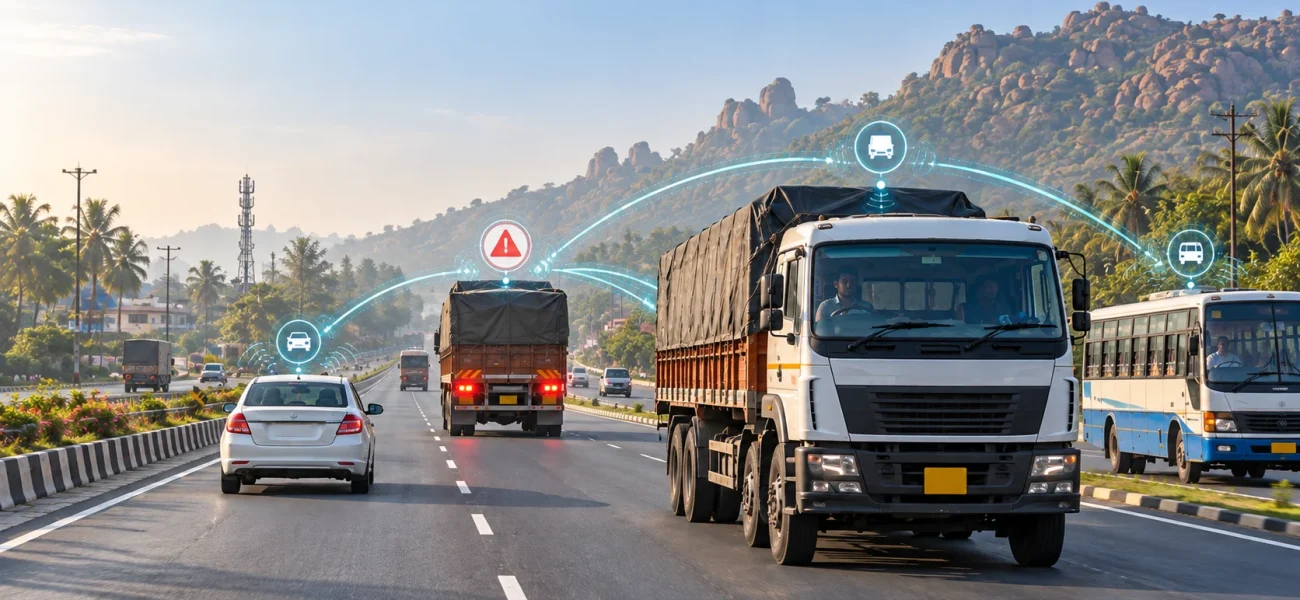
The next step is Vehicle-to-Vehicle (V2V) communication, which allows compatible vehicles to exchange safety-related information such as speed, position and braking events.
In 2026, MoRTH proposed draft rules referencing AIS-230 for V2V systems. Under the proposal, L, M and N category vehicles manufactured from October 1, 2028 would be required to have AIS-230-compliant V2V systems, while vehicles fitted with V2V from October 1, 2027 would need to comply with the standard.
These are draft provisions and subject to final notification.
For fleet operators, the key question is: How can V2V improve fleet safety, and how can businesses prepare for connected vehicles today?
What Is V2V Communication?
Vehicle-to-Vehicle (V2V) communication is a connected-vehicle technology that allows vehicles to exchange information with other nearby vehicles.
Instead of relying only on what a driver can see or what a vehicle’s onboard sensors can detect, V2V allows compatible vehicles to communicate information such as:
- Vehicle speed
- Position
- Direction of travel
- Acceleration and deceleration
- Sudden braking events
- Other safety-related information
This information can help vehicles or drivers receive earlier warnings about potential hazards.
For example, imagine a truck travelling on a highway behind another heavy vehicle. If the vehicle ahead suddenly brakes, a compatible V2V system could communicate that event to the following vehicle, potentially providing an additional warning before the driver has a clear line of sight.
That additional layer of awareness could become particularly valuable on busy highways, at intersections and in situations where visibility is limited.
What Has India Proposed for V2V Communication?
MoRTH’s August 2026 draft notification proposes a phased framework for V2V systems in L, M and N category vehicles.
The proposed timeline is:
| Proposed date | Draft requirement |
|---|---|
| 1 October 2027 | L, M and N category vehicles fitted with V2V systems would need to comply with AIS-230 |
| 1 October 2028 | L, M and N category vehicles would be required to be fitted with V2V systems conforming to AIS-230 |
The government says the phased approach is intended to give vehicle manufacturers and other stakeholders time to prepare for implementation. The draft also states that comments and suggestions would be examined before the final notification is issued.
Why the 2027 and 2028 dates matter
Fleet operators should be careful about interpreting these dates.
They currently belong to a draft regulatory proposal, not a completed mandatory requirement applicable to every vehicle on the road.
However, the proposal is still significant because it indicates the direction in which India’s connected-vehicle and road-safety ecosystem is moving.
Fleet businesses purchasing new commercial vehicles over the coming years should therefore monitor developments from MoRTH, vehicle manufacturers and technology providers.
What Is AIS-230?
AIS-230 is the technical foundation referenced in India’s proposed V2V framework.
According to MoRTH, the standard establishes minimum requirements covering areas such as:
- Radio performance
- Frequency stability
- Output power
- Receiver sensitivity and selectivity
- GNSS and positioning
- Electrical and power-supply requirements
- Electromagnetic compatibility
- Cybersecurity
- Communication security
- Performance for road-safety applications
The proposed systems use factory-installed On-Board Units (OBUs) based on Cellular Vehicle-to-Everything (C-V2X) technology.
For fleet operators, this means V2V is not simply another GPS tracking feature. It is part of a broader connected-vehicle architecture designed specifically to enable vehicles to communicate safety information.
How Does V2V Communication Work?
A simplified V2V communication process looks like this:
Vehicle → On-Board Unit → Wireless Communication → Nearby Vehicle → Safety Warning
A compatible vehicle collects information about its current operating condition. The V2V system communicates relevant information to nearby vehicles, allowing those vehicles or their safety systems to assess potential risks.
For example:
- A vehicle detects sudden braking.
- Its V2V system communicates the event.
- Nearby compatible vehicles receive the information.
- The receiving vehicle evaluates the potential risk.
- The driver or vehicle system can receive an appropriate warning.
This can complement traditional vehicle sensors because communication can provide information about events occurring beyond the receiving vehicle’s immediate line of sight.
What Safety Problems Can V2V Help Address?
The proposed Indian framework identifies several safety use cases for V2V communication.
Emergency Brake Alert
A vehicle suddenly applying the brakes can create a serious risk for following vehicles, particularly heavy trucks and buses that require greater stopping distance.
An emergency brake alert could provide an additional warning to vehicles approaching from behind.
Forward Collision Warning
V2V information can help identify situations where two vehicles may be approaching each other in a way that creates collision risk.
This can supplement existing driver-assistance technologies.
Wrong-Way Driving
Wrong-way vehicles can create extremely dangerous situations, especially on divided highways and high-speed roads.
Connected vehicles could potentially communicate information about such events to nearby vehicles.
Emergency Vehicle Alert
Emergency vehicles such as ambulances, fire engines and police vehicles need to move quickly through traffic.
Connected communication can support warnings about approaching emergency vehicles and help surrounding road users become aware of their presence.
MoRTH also identifies applications involving situations such as unsafe lane changes and other collision-risk scenarios.
V2V Communication vs GPS Tracking
V2V and GPS tracking serve different purposes.
| V2V Communication | GPS Tracking |
|---|---|
| Vehicle-to-vehicle safety communication | Vehicle-to-platform communication |
| Focuses on nearby vehicles | Focuses on fleet visibility |
| Supports real-time safety alerts | Supports location and operational monitoring |
| Can communicate information beyond direct line of sight | Provides location, route and movement information |
| Primarily supports connected-road safety | Supports fleet management and business operations |
For fleet operators, V2V should therefore not be viewed as a replacement for GPS tracking.
A modern fleet can benefit from both technologies.
GPS tracking helps the fleet manager understand where the vehicle is and how it is being operated, while V2V can help vehicles become more aware of what nearby connected vehicles are doing.
V2V Communication vs Telematics
Telematics combines vehicle data, connectivity and software to provide fleet operators with operational intelligence.
A telematics platform can help monitor:
- Vehicle location
- Trip history
- Driver behaviour
- Vehicle utilisation
- Idling
- Fuel consumption
- Engine information
- Maintenance-related data
- Route performance
V2V operates at a different level.
Its primary purpose is real-time communication between vehicles and connected road participants for safety-related applications.
This makes V2V a potential additional layer of connected fleet safety, rather than a replacement for telematics.
Why V2V Could Be Important for Commercial Fleets
Commercial vehicles spend long hours on roads and highways. Trucks, buses, tankers, construction vehicles and logistics fleets can encounter rapidly changing traffic conditions every day.
For these fleets, even a small improvement in hazard awareness can have significant operational value.
V2V could eventually support scenarios such as:
- Sudden braking alerts between heavy vehicles
- Collision-risk warnings
- Wrong-way vehicle alerts
- Emergency vehicle notifications
- Improved awareness at complex intersections
- Additional safety information during highway operations
The biggest potential benefit is earlier awareness.
A driver may not immediately see a hazard because another vehicle, road geometry, darkness, fog or traffic may block the driver’s view. Connected communication could provide another source of information.
Why Heavy Vehicles May Benefit Significantly
Heavy commercial vehicles have different operating characteristics from passenger cars.
A fully loaded truck cannot stop as quickly as a smaller vehicle. Tankers and other specialised vehicles may also carry cargo that requires additional safety precautions.
Consider a highway convoy:
Truck A → Truck B → Truck C
If Truck A brakes suddenly, Truck B may detect the event through its own sensors and driver observation. With compatible V2V communication, the braking event could also be communicated electronically.
Truck C could potentially receive the information even before the driver has a complete visual understanding of the situation.
This does not eliminate the need for safe following distances or responsible driving. Instead, it could provide an additional safety layer.
Can Fleet Operators Improve Safety Before V2V Becomes Common?
Yes.
Fleet operators do not need to wait for widespread V2V deployment to improve connected fleet safety.
Existing technologies can already provide important visibility into vehicle and driver behaviour.
A practical connected fleet strategy can combine:
GPS Tracking
Use real-time vehicle location, route monitoring, geofencing and trip visibility to understand where vehicles are operating.
Vehicle Telematics
Monitor vehicle and operational information to identify abnormal behaviour, utilisation issues and other fleet trends.
Driver Behaviour Monitoring
Track events such as harsh braking, harsh acceleration, speeding and other driving patterns to identify coaching opportunities.
Dashcams and 360° Cameras
Use video evidence to understand road incidents, risky driving events and accident circumstances.
Fuel Monitoring
Monitor fuel consumption and unusual fuel-level changes to improve cost control and operational visibility.
Preventive Maintenance
Use vehicle data and maintenance schedules to reduce avoidable breakdowns and improve vehicle availability.
Together, these technologies create a connected safety and fleet-management foundation that can complement future V2V capabilities.
A Practical Connected Fleet Safety Roadmap
Fleet operators can prepare for the connected-vehicle future through a phased approach.
Step 1: Build Real-Time Fleet Visibility
Start with GPS tracking and a central fleet-management platform.
Fleet managers should be able to understand vehicle location, movement and operational status without relying entirely on phone calls or manual updates.
Step 2: Monitor Driver Behaviour
Identify risky driving patterns such as:
- Overspeeding
- Harsh braking
- Harsh acceleration
- Excessive idling
- Unusual route behaviour
Use the information for driver coaching rather than simply collecting data.
Step 3: Add Video-Based Safety
Dashcams can provide visual context that GPS data alone cannot provide.
When an accident or dangerous event occurs, location data can show where it happened, while video can help explain what happened.
Step 4: Connect Vehicle Data
Telematics and CAN Bus integration can provide deeper information about vehicle operation and performance.
This creates a stronger foundation for predictive maintenance, operational monitoring and fleet analytics.
Step 5: Prepare for Connected Vehicles
As V2V and other V2X technologies become more widespread, fleet operators should evaluate vehicle compatibility, OEM capabilities, cybersecurity requirements and technology integration.
The goal should not be to purchase every new technology immediately.
The goal should be to build a fleet technology architecture that can evolve.
What Should Fleet Operators Do About the 2026 V2V Draft?
Fleet operators should take a practical approach.
First, monitor the final regulatory notification.
The current dates and requirements come from the draft framework and may need to be considered alongside the final notification and subsequent implementation guidance.
Second, discuss future vehicle specifications with OEMs.
When purchasing new commercial vehicles, businesses can ask manufacturers about connected-vehicle capabilities, V2V readiness and relevant standards.
Third, strengthen existing fleet visibility.
GPS tracking, telematics, dashcams and driver-behaviour monitoring can provide immediate operational and safety benefits while the V2V ecosystem develops.
Fourth, consider technology interoperability.
Fleet operators should avoid creating disconnected technology systems that cannot share useful data.
Finally, treat cybersecurity as part of fleet safety.
As more vehicles become connected, communication security and cybersecurity become increasingly important. AIS-230 itself includes cybersecurity and communication-security provisions.
Challenges of V2V Adoption in India
V2V has significant potential, but implementation across India’s diverse road environment will take time.
Vehicle Compatibility
The benefits of direct vehicle communication increase as more compatible vehicles participate in the ecosystem.
Infrastructure and Ecosystem Development
Connected mobility requires coordination among vehicle manufacturers, technology providers, regulators, telecom stakeholders and other participants.
Cybersecurity
Connected vehicles introduce new digital communication pathways, making security an essential consideration.
Fleet Technology Integration
Commercial fleets may already use GPS, telematics, dashcams, fuel sensors and other systems. Integrating future V2V capabilities into existing technology environments will require careful planning.
Driver and Fleet Manager Training
Technology alone cannot eliminate road accidents. Drivers and fleet managers still need effective safety processes, training and accountability.
V2V Is an Additional Layer of Fleet Safety
One of the most important points for fleet operators is that V2V should not be treated as a replacement for existing fleet technology.
Think of a connected fleet as multiple layers:
GPS Tracking → Fleet Visibility
Telematics → Vehicle Intelligence
Dashcams → Visual Evidence
Driver Monitoring → Behavioural Safety
Fuel Monitoring → Cost Control
V2V → Connected Vehicle Safety
Each technology addresses a different part of the fleet operation.
When these systems work together, fleet managers can move from simply knowing where vehicles are to understanding how vehicles, drivers and road conditions interact.
How Diselmap Can Support the Connected Fleet Journey
Diselmap helps businesses build a stronger foundation for connected fleet operations through technologies such as GPS tracking, fleet management, fuel monitoring, telematics, driver-safety solutions, dashcams and vehicle data integration.
For businesses preparing for the next generation of connected mobility, the immediate priority is not necessarily to wait for V2V adoption.
It is to establish reliable fleet visibility today.
A connected fleet platform can help businesses monitor vehicles, understand driver behaviour, improve operational control and create the data foundation needed for future technologies.
The Future of V2V Communication in India
The proposed V2V framework represents an important step toward a more connected road-transport ecosystem in India.
If implemented as proposed, AIS-230-based systems could enable compatible vehicles to exchange safety information and support applications such as emergency braking alerts, forward collision warnings, wrong-way driving alerts and emergency vehicle notifications.
But V2V will be only one part of the larger connected mobility ecosystem.
The future of fleet safety is likely to involve multiple technologies working together:
GPS + Telematics + ADAS + Dashcams + Vehicle Data + V2V + Intelligent Transport Systems
For fleet operators, the smartest strategy is to build this foundation progressively rather than treating each technology as an isolated investment.
Frequently Asked Questions
What is V2V communication in India?
V2V communication is a connected-vehicle technology that allows nearby compatible vehicles to exchange information such as speed, position, direction and braking events to support safety-related applications.
What are India's proposed V2V rules for 2026?
In August 2026, MoRTH issued a draft notification proposing phased V2V implementation through amendments to the Central Motor Vehicles Rules, 1989. The proposal references AIS-230 and sets proposed implementation dates beginning in 2027 and 2028.
Is V2V mandatory in India right now?
The August 2026 provisions are a draft proposal, not a final nationwide mandatory requirement. Fleet operators should wait for the final notification and subsequent implementation requirements before treating the proposed dates as final law.
What is AIS-230?
AIS-230 is the Indian automotive standard referenced in the proposed V2V framework. It specifies technical, functional, performance, environmental, cybersecurity and communication-security requirements for V2V systems.
Will V2V replace GPS tracking?
No. V2V and GPS tracking serve different purposes. V2V focuses primarily on communication between nearby vehicles for safety applications, while GPS tracking provides fleet managers with vehicle location and operational visibility.
Can V2V prevent accidents?
V2V is designed to provide additional safety information and earlier warnings in certain situations. It can support proactive accident prevention, but it cannot guarantee that accidents will be prevented.
What should fleet operators do now?
Fleet operators should monitor the final V2V regulations, discuss future vehicle compatibility with OEMs and strengthen existing fleet technologies such as GPS tracking, telematics, dashcams, driver-behaviour monitoring and vehicle-data systems.
Final Takeaway
V2V communication in India could become an important part of the country’s future road-safety and connected-mobility ecosystem.
The 2026 MoRTH draft provides a proposed regulatory direction based on AIS-230, with phased requirements for V2V-equipped and newly manufactured L, M and N category vehicles. However, the proposed 2027 and 2028 dates should be treated as draft provisions until the final notification is issued.
For fleet operators, the message is simple: don’t wait for V2V to start building a connected fleet.
GPS tracking, telematics, dashcams, driver-behaviour monitoring, fuel monitoring and vehicle data can already improve visibility, safety and operational control.
As V2V develops, these technologies can become part of a broader connected fleet ecosystem—helping Indian businesses move toward safer, smarter and more data-driven transportation.
Make Your Fleet V2V-Ready Today
V2V technology is shaping the future of road safety. Prepare your fleet today with reliable GPS tracking, vehicle monitoring, and driver safety solutions.
Make your fleet smarter, safer, and future-ready with Diselmap.