
- Our Article
Brent Crude Crosses $100: What Rising Oil Prices Mean for Indian Fleets in 2026
The global oil market is once again creating a potential cost challenge for businesses that depend heavily on road transportation.
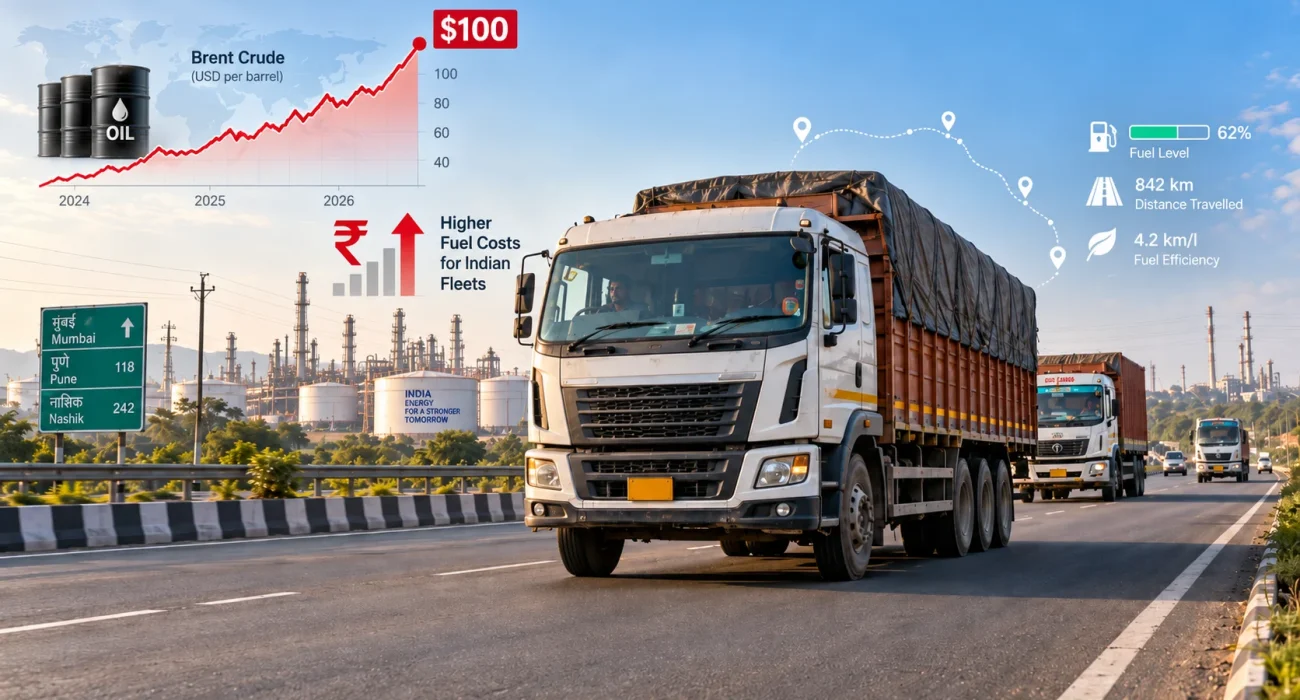
On September 9, 2026, Brent crude oil prices moved above $100 per barrel as escalating Middle East tensions increased concerns about global oil supply. At the same time, the Indian rupee moved beyond the ₹95-per-dollar level, adding pressure to an economy that relies significantly on imported crude oil. Reuters reported that the Reserve Bank of India was likely intervening in the foreign-exchange market as the rupee came under pressure.
For Indian fleet operators, however, the issue is bigger than movements in global financial markets.
Higher crude prices can contribute to pressure across the transportation ecosystem, including fuel costs, logistics expenses, route economics and operating margins. The impact can be particularly significant for businesses running trucks, buses, construction vehicles, tankers, delivery vehicles and other high-mileage commercial fleets.
This makes fuel efficiency, fuel monitoring and fleet cost control increasingly important for Indian businesses.
What Is Happening With Oil Prices?
Brent crude is one of the world’s major oil price benchmarks. When global supply risks increase, crude prices can rise quickly as traders price in the possibility of tighter availability.
On September 9, Brent crude futures moved above $100 per barrel, reaching a six-week high as the Middle East conflict intensified concerns about supply disruptions. Reuters reported that Brent futures reached around $100.95 during the session.
The situation also affected the Indian rupee.
Reuters reported that the rupee fell past ₹95 per U.S. dollar on September 9 and closed at approximately ₹95.1050, while oil prices were rising.
For India, this combination matters because crude oil is internationally traded in U.S. dollars.
In simple terms:
Higher crude prices + a weaker rupee = greater potential pressure on India’s oil import bill.
That does not mean diesel prices at Indian fuel stations automatically increase by the same amount or on the same day. Retail fuel prices are influenced by several factors, including international prices, exchange rates, refining economics, taxes and pricing decisions.
For fleet operators, the more useful question is therefore:
How can a business protect fleet margins when fuel costs become more volatile?
Why Rising Oil Prices Matter to Indian Fleets
Fuel is one of the largest controllable operating expenses for many commercial fleets.
A long-haul truck travelling thousands of kilometres every month can consume a substantial volume of diesel. The same is true for buses, construction fleets, mining vehicles, tankers, distribution vehicles and other commercial applications.
When fuel becomes more expensive, even a small increase in the cost per litre can become significant across a large fleet.
For example, consider a truck that:
- Travels 8,000 km per month
- Delivers approximately 4 km per litre
- Consumes around 2,000 litres of fuel per month
If the effective fuel cost increases by only ₹2 per litre, the additional monthly fuel expense would be:
2,000 litres × ₹2 = ₹4,000 per truck
For a fleet of 50 similar vehicles:
₹4,000 × 50 = ₹2,00,000 additional monthly fuel expense
This is only an illustrative calculation. Actual fuel consumption varies according to vehicle type, load, road conditions, traffic, route profile, driving behaviour, maintenance condition and operating environment.
The important lesson is that small changes in fuel economics can create large fleet-level financial impacts.
Rising Fuel Costs Can Expose Hidden Fleet Inefficiencies
An increase in fuel prices does not create every fleet problem.
Instead, it can make existing inefficiencies more expensive.
Consider two vehicles travelling the same distance.
Vehicle A operates efficiently with controlled idling, appropriate routes, disciplined driving and good maintenance.
Vehicle B spends more time idling, takes inefficient routes, experiences aggressive acceleration and braking, and has inconsistent maintenance.
When fuel is relatively inexpensive, the difference may appear manageable.
When fuel costs rise, the financial gap becomes much more visible.
This is why fleet operators should not focus only on the price of fuel.
They should also monitor how efficiently every litre is being used.
Why Fuel Monitoring Becomes More Important When Oil Prices Rise
Fuel monitoring provides fleet managers with visibility into fuel consumption rather than relying only on fuel bills or driver-reported information.
A connected fuel-management approach can help businesses identify:
- Fuel consumption by vehicle
- Fuel consumption trends
- Unexpected fuel-level changes
- Excessive fuel usage
- Fuel consumption compared with distance travelled
- Potential fuel theft or leakage
- Vehicles with abnormal consumption patterns
This information allows fleet managers to move from a reactive approach to a more data-driven approach.
Instead of asking:
“Why did our fuel bill increase this month?”
A fleet manager can ask:
“Which vehicles, routes or operating behaviours contributed most to the increase?”
That distinction can make fleet cost management far more effective.
Five Fleet Areas Businesses Should Monitor
1. Fuel Consumption Per Vehicle
Fleet-wide averages can hide individual vehicle problems.
One truck may consume significantly more fuel than another because of its route, load, mechanical condition or driving behaviour.
Monitoring consumption at vehicle level helps fleet managers identify unusual patterns.
The goal is not simply to reduce fuel consumption at any cost.
The goal is to understand whether each vehicle is consuming fuel efficiently for the work it performs.
2. Excessive Idling
Idling consumes fuel without moving the vehicle.
Delivery vehicles waiting at customer locations, trucks operating in congested areas and construction vehicles working at sites can spend significant periods with engines running while stationary.
Tracking idle time can help fleet managers identify unnecessary fuel consumption.
Reducing avoidable idling can therefore become one of the simplest operational steps toward better fuel efficiency.
3. Route Efficiency
A vehicle travelling unnecessary kilometres consumes unnecessary fuel.
Poor route planning can result from:
- Traffic congestion
- Unplanned diversions
- Repeated trips
- Poor dispatch coordination
- Incorrect route selection
- Excessive empty kilometres
GPS-based visibility can help fleet teams understand how vehicles actually travel rather than relying entirely on planned routes.
This makes route efficiency an important part of fuel-cost control.
4. Driver Behaviour
Driver behaviour has a direct influence on vehicle efficiency.
Aggressive acceleration, harsh braking, excessive speeding and unnecessary idling can increase fuel consumption and vehicle wear.
Driver behaviour monitoring can help fleet managers identify patterns and provide targeted training.
The objective should not be simply to penalise drivers.
The objective should be to create safer, more consistent and more fuel-efficient driving practices.
5. Unusual Fuel Consumption
Sudden changes in fuel consumption deserve investigation.
For example, if a vehicle normally operates within a relatively consistent consumption range but suddenly begins consuming substantially more fuel, the fleet team can investigate possible causes.
These may include:
- Mechanical problems
- Route changes
- Increased loads
- Excessive idling
- Driving behaviour
- Fuel leakage
- Potential fuel theft
- Sensor or data issues
Early detection can prevent a small problem from becoming a recurring operating expense.
Fuel Price Is Only One Part of the Problem
It is easy to think about fleet fuel costs simply as:
Fuel price × fuel consumed
In reality, fleet fuel economics are influenced by several operational variables.
A more useful way to look at the problem is:
Total fuel cost = fuel price × actual consumption
And actual consumption is affected by factors such as:
Distance + vehicle condition + load + route + traffic + driving behaviour + idling
This means fleet managers cannot control global crude prices.
But they can improve many of the operational factors that determine how efficiently fuel is used.
That is where technology becomes valuable.
How GPS Tracking Can Support Fuel Cost Control
GPS tracking is often associated with vehicle location and security.
But modern fleet tracking can provide much more operational visibility.
When GPS data is combined with vehicle and fuel information, fleet managers can analyse the relationship between:
- Distance travelled
- Routes
- Vehicle movement
- Stops
- Idling
- Driver behaviour
- Fuel consumption
For example, if a vehicle is consuming more fuel than expected, its GPS history can help determine whether it travelled additional kilometres, spent excessive time idling or followed an inefficient route.
This turns location data into an operational cost-control tool.
For businesses looking to improve vehicle visibility, a dedicated GPS Tracking System can form an important part of a connected fleet strategy.
The Role of Telematics in a High-Fuel-Cost Environment
Telematics connects vehicle data with fleet-management operations.
Instead of looking at fuel, GPS, vehicle performance and driver behaviour separately, fleet managers can bring these signals together.
A connected telematics environment can help answer questions such as:
- Which vehicles are travelling the most kilometres?
- Which vehicles consume the most fuel?
- Which routes are generating excessive distance?
- Which drivers show repeated inefficient driving patterns?
- Which vehicles spend too much time idling?
- Which vehicles may require maintenance attention?
This broader view is especially useful when operating costs are under pressure.
For businesses managing larger commercial fleets, telematics solutions can help create a more connected operating environment in which decisions are based on actual vehicle data.
What Rising Oil Prices Could Mean for Indian Logistics
The impact of higher oil prices may extend beyond the fuel tank.
Transportation is connected to almost every stage of the Indian supply chain.
Higher operating costs can influence:
- Freight transportation
- Distribution
- Construction logistics
- E-commerce delivery
- Passenger transport
- Manufacturing supply chains
- Agriculture logistics
- Mining operations
- Infrastructure projects
For fleet-dependent businesses, sustained fuel-cost pressure can affect margins and pricing decisions.
That is why fleet efficiency should be treated as a business issue rather than only a transport-department issue.
What Fleet Managers Should Do Now
Fleet operators do not need to wait for another fuel-price increase before improving efficiency.
A practical approach can begin with five steps.
1. Audit Current Fuel Consumption
Establish a baseline for each vehicle.
Measure fuel usage against distance, operating conditions and vehicle type rather than looking only at total monthly fuel expenditure.
2. Identify High-Consumption Vehicles
Look for vehicles that consistently perform outside expected consumption ranges.
These vehicles deserve further investigation before the problem becomes a recurring cost.
3. Monitor Idling
Measure how much time vehicles spend stationary with engines running.
Separate operationally necessary idling from avoidable idling.
4. Improve Route Planning
Compare planned routes with actual vehicle movement.
Look for unnecessary kilometres, repeated journeys, traffic-related delays and excessive empty running.
5. Track Driver Behaviour
Use driving data to identify patterns such as harsh acceleration, harsh braking, speeding and prolonged idling.
Then use the information for coaching and driver-performance improvement.
Why Fuel Management Is Becoming a Strategic Fleet Function
Fuel management is no longer simply about recording how much diesel was purchased.
Modern fuel management is about understanding where fuel is being consumed, why it is being consumed and whether that consumption is justified by the work performed.
This becomes particularly important when external factors such as crude-oil volatility increase uncertainty.
A fleet that has strong operational visibility can respond more quickly because managers can identify inefficiencies before they become large recurring expenses.
That is the difference between:
Reacting to higher fuel bills
and
Managing the operational causes behind those bills.
A Connected Approach to Fleet Cost Control
Fuel efficiency rarely comes from one technology alone.
A stronger fleet strategy combines multiple data points.
GPS Tracking
Provides visibility into vehicle location, routes, distance and movement.
Fleet Management
Helps managers coordinate vehicles, operations, schedules and utilisation.
Telematics
Connects vehicle and operational data for deeper analysis.
Fuel Monitoring
Provides visibility into fuel levels, consumption patterns and unusual events.
Driver Behaviour Monitoring
Helps identify driving practices that may affect safety, fuel efficiency and vehicle wear.
Maintenance Monitoring
Helps identify vehicle-condition issues that may contribute to poor efficiency.
Together, these technologies can create a connected approach to fleet cost management.
What This Oil Shock Teaches Fleet Operators
Global oil prices are outside the control of most fleet operators.
Geopolitical events, supply disruptions, exchange rates and international commodity markets can change quickly.
Fleet efficiency, however, is something businesses can actively manage.
The lesson for Indian fleet operators is therefore not simply to watch Brent crude.
It is to understand how changes in the external fuel environment affect their own vehicles and operations.
When fuel costs rise, businesses with accurate operational data can identify where fuel is being consumed inefficiently and take targeted action.
That can mean better routes, lower idling, improved driving behaviour, faster identification of abnormal consumption and stronger fleet utilisation.
In a volatile fuel environment, visibility becomes a cost-control advantage.
Frequently Asked Questions
Does Brent crude crossing $100 mean diesel prices will immediately rise in India?
No. A rise in Brent crude does not automatically translate into an immediate one-for-one increase in Indian diesel prices. Fuel pricing is influenced by international oil prices, exchange rates, refining economics, taxes and other market factors.
Why does crude oil matter to India's fuel market?
India relies heavily on imported crude oil. International crude prices and the rupee-dollar exchange rate therefore influence the economics of importing and processing petroleum products.
How does a weaker rupee affect India's oil costs?
Crude oil is internationally traded in U.S. dollars. When the rupee weakens against the dollar, the rupee cost of imported commodities can come under additional pressure, all else being equal.
How do higher oil prices affect fleet operators?
Higher fuel costs can increase vehicle operating expenses, transportation costs and pressure on fleet margins. The impact is generally greater for high-mileage fleets and fuel-intensive commercial vehicles.
Can fleet management reduce the impact of rising fuel costs?
Fleet management cannot control global crude prices, but it can help businesses reduce avoidable fuel consumption through better route planning, vehicle utilisation, driver monitoring, idling control and operational visibility.
How does fuel monitoring help transport companies?
Fuel monitoring helps fleet managers understand consumption patterns and identify unusual fuel-level or usage events. It can support investigation into excessive consumption, leakage, theft or operational inefficiency.
Can GPS tracking help reduce fuel consumption?
Yes. GPS tracking can help identify unnecessary kilometres, inefficient routes, excessive stops and prolonged idling. When combined with fuel and vehicle data, it can provide a stronger picture of fleet efficiency.
Conclusion: Make Every Litre Count
Brent crude moving above $100 per barrel is a reminder that global energy markets can quickly become a business-cost issue for Indian transportation and logistics companies. At the same time, the rupee’s movement beyond ₹95 per dollar adds another factor that fleet-dependent businesses need to watch.
Fleet operators cannot control international oil prices.
But they can control how efficiently their vehicles use fuel.
By combining fuel monitoring, GPS tracking, fleet management, telematics, driver behaviour monitoring and maintenance visibility, businesses can better understand their fuel consumption and act on avoidable inefficiencies.
For a high-mileage fleet, even small improvements repeated across dozens or hundreds of vehicles can create meaningful savings.
The goal is simple: use better data to make every kilometre—and every litre—count.
For businesses looking to improve fleet visibility and fuel efficiency, explore DiselMap’s connected fleet technology solutions.
Make Every Litre Count with DiselMap
Rising fuel costs can quickly increase fleet operating expenses—but better visibility can help you identify where fuel is being lost and where efficiency can improve.
With DiselMap, businesses can bring together GPS tracking, fuel monitoring, fleet management and telematics to gain better visibility into vehicle operations and fuel consumption.
Monitor your fleet. Reduce avoidable fuel costs. Improve operational efficiency.