
- Our Article
360 Degree Camera for Trucks: How Surround View Improves Fleet Safety
Large commercial trucks are difficult to see around completely from the driver’s seat. Their length, height, body design and turning radius can create visibility gaps around the front, sides and rear of the vehicle.A 360 degree camera for trucks gives drivers a wider view of the area around the vehicle by combining footage from multiple cameras. In compatible systems, those camera feeds are processed into a single bird’s-eye or surround-view image that can be displayed inside the cab.
For logistics fleets, construction vehicles, buses, tankers and other heavy commercial vehicles, this additional visibility can be especially useful during reversing, turning, parking, loading and manoeuvring in restricted areas.Rather than replacing mirrors or safe driving practices, surround-view technology gives drivers another source of visual information for understanding what is happening close to the vehicle.
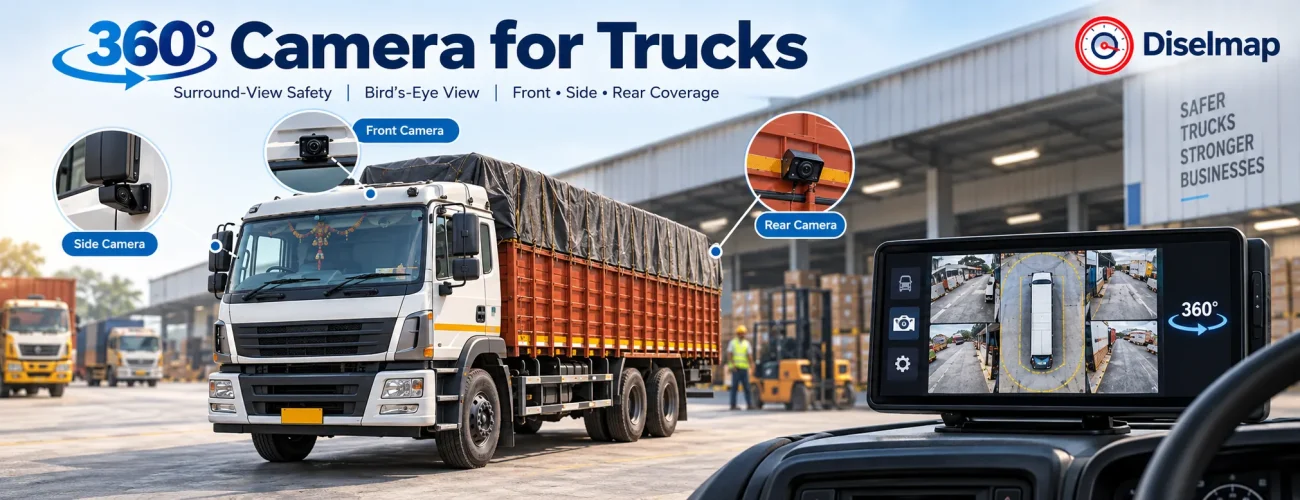
What Is a 360 Degree Camera System for Trucks?
A 360-degree surround-view system is a multi-camera vehicle monitoring setup designed to show the area around a truck from several directions at the same time.
Cameras are generally installed around the vehicle, such as at the:
- Front
- Rear
- Left side
- Right side
Depending on the truck configuration and system design, additional cameras may also be used.
The video feeds overlap and are processed by the system to create a wider view of the vehicle’s surroundings. Many systems can generate a top-down bird’s-eye view, while others allow drivers to switch between front, rear, side and combined views.
Commercial surround-view systems available today commonly use four or more camera channels, although the number varies according to vehicle length and application.
In simple terms:
Multiple cameras → image processing → combined surround view → driver display
This makes it easier for a driver to understand what is happening around a large vehicle without depending on one camera angle alone.
How Does a 360° Truck Camera System Work?
Although systems differ between manufacturers, the basic process is straightforward.
1. Multiple Cameras Capture the Vehicle Surroundings
Wide-angle cameras are positioned around the commercial vehicle.
A typical arrangement may include:
- Front camera
- Rear camera
- Left-side camera
- Right-side camera
Long trailers, buses, construction equipment and other specialised vehicles may require additional camera channels.
Modern commercial systems can support four, five or six-channel panoramic configurations depending on the application.
2. Camera Feeds Are Processed Together
The individual camera images overlap.
Image-processing software corrects distortion and combines these feeds to create a more continuous visual representation around the vehicle.
Some commercial systems describe this process as panoramic image synthesis or AVM, meaning Around View Monitoring.
The result can look like the truck is being viewed from above, even though there is no camera physically positioned above the vehicle.
3. The Driver Sees the Surrounding Area on a Monitor
The processed video appears on an in-cab display.
Depending on the configuration, the driver may be able to view:
- Bird’s-eye surround view
- Rear camera
- Left-side camera
- Right-side camera
- Front camera
- Split-screen views
- 2D or 3D visualisations
This makes the system particularly useful when space around the truck is limited.
4. The View Can Change During Vehicle Manoeuvres
Compatible systems may use vehicle inputs to change the camera display automatically.
For example:
- Selecting reverse can show the rear area more prominently.
- Operating a turn indicator can display the corresponding side.
- Certain systems may highlight a particular camera when an event is detected.
These capabilities depend on the selected camera hardware and installation rather than being universal features of every 360° camera system.
Why Commercial Trucks Have Serious Visibility Challenges
Visibility around a passenger car and visibility around a commercial truck are very different problems.
Large trucks can have:
- Long bodies
- High driving positions
- Multiple axles
- Large rear overhangs
- Trailers
- Wide turning paths
- Areas close to the vehicle that are difficult to see directly
These characteristics create areas where another vehicle, pedestrian, cyclist, worker or object may not be immediately visible to the driver.
International vehicle regulations also specifically address areas such as blind-spot information, rear visibility and awareness of vulnerable road users. UNECE Regulation No. 151 on Blind Spot Information Systems covers blind-spot information for detecting bicycles, while UNECE Regulation No. 158 on rear visibility and detection addresses devices for reversing visibility and awareness behind vehicles.
For fleet operators, better visibility matters particularly during low-speed manoeuvres where vehicles operate close to people, structures and equipment.
How Surround-View Cameras Improve Fleet Safety
The main purpose of a 360° vehicle camera is not simply to record more video.
Its most useful role is improving situational awareness around the vehicle.
Better Awareness of Visibility Gaps
Side and rear cameras can show areas that are difficult to monitor using direct vision alone.
A combined surround view can help a driver notice:
- Pedestrians
- Cyclists
- Motorcycles
- Smaller vehicles
- Barriers
- Loading equipment
- Workers
- Other nearby objects
It is safer to describe this as reducing blind-spot or visibility gaps, rather than claiming that a camera system permanently eliminates every blind spot.
Camera coverage still depends on installation, calibration, lens cleanliness, lighting and vehicle configuration.
Safer Reversing
Reversing is especially difficult for trucks because the driver cannot directly see what is behind a large vehicle body.
A surround-view camera can provide rear visibility together with information from the sides of the truck.
This can be useful when:
- Reversing into loading bays
- Parking in a fleet yard
- Moving around a construction site
- Approaching warehouse docks
- Reversing near workers or equipment
UNECE Regulation No. 158 specifically addresses rear visibility or detection and driver awareness of vulnerable road users behind vehicles.
Better Visibility During Turns
Truck turning movements are different from those of smaller vehicles.
The rear wheels follow a different path from the front wheels, and the side of a long truck can pass close to objects or road users during a turn.
Side-camera views can provide another visual reference during these manoeuvres.
Easier Movement Through Tight Spaces
Commercial vehicles frequently operate in areas that were not designed with large trucks in mind.
Examples include:
- Narrow industrial roads
- Warehouse yards
- Loading docks
- Construction sites
- Crowded depots
- Urban delivery locations
A bird’s-eye view can make it easier for drivers to understand vehicle position relative to nearby obstacles.
360° Camera vs Dashcam vs Reversing Camera
These technologies are related, but they serve different purposes.
| Technology | Main Purpose | Typical Coverage |
|---|---|---|
| Dashcam | Record journeys and driving events | Primarily front-facing, sometimes cabin/rear |
| Reversing camera | Help the driver see behind the vehicle | Rear |
| Side camera | Improve visibility beside the vehicle | Left or right side |
| 360° surround-view system | Provide wider awareness around the vehicle | Front, rear and sides |
| Connected fleet camera system | Combine video with fleet information | Multiple cameras plus vehicle data |
A dashcam is primarily useful for recording road events and providing visual context after an incident.
You can learn more about that use case in Diselmap’s dashcam evidence and road accident guide.
A surround-view system has a different primary purpose: helping the driver understand what is happening around the truck while the vehicle is operating.
That difference is important for preventing keyword cannibalization between the two topics.
Where Is a 360 Degree Camera for Trucks Most Useful?
Surround-view technology can be useful across several commercial fleet environments.
Logistics and Long-Haul Trucks
Logistics vehicles may spend much of their journey on highways, but difficult manoeuvres often occur at the beginning and end of each trip.
A truck may need to:
- Leave a crowded transport yard
- Enter customer premises
- Reverse toward a loading dock
- Park between other commercial vehicles
- Navigate narrow industrial roads
These are situations where wider visual coverage can be particularly valuable.
For broader vehicle and operational monitoring, fleets can combine camera technology with a Fleet Management System.
Construction and Mining Vehicles
Construction sites are dynamic environments.
Tippers, dump trucks, excavators, loaders, concrete mixers and other equipment may operate close to:
- Workers
- Temporary structures
- Material piles
- Excavations
- Heavy machinery
- Other vehicles
Commercial surround-view technology is also used on heavy equipment to improve visibility during reversing, turning and precision manoeuvres.
For fleets operating in these environments, camera monitoring can complement construction and mining fleet technology.
Buses and Passenger Transport
Large buses also have areas that can be difficult to observe directly from the driver’s position.
Surround visibility can assist during:
- Bus terminal movement
- Parking
- Reversing
- Tight turns
- Depot operations
- Approaching passenger areas
The camera should complement mirrors, trained observation and established operating procedures rather than replace them.
Tankers and Specialised Commercial Vehicles
Tankers and other long commercial vehicles may require additional visibility because of their length and manoeuvring characteristics.
Camera placement should therefore be planned according to the actual vehicle body and operating environment.
Can 360° Cameras Detect Pedestrians and Vehicles?
Some systems can, but this feature should not be assumed for every surround-view camera.
A basic 360° system primarily provides video.
More advanced systems may use AI-based computer vision to identify:
- Pedestrians
- Cyclists
- Vehicles
- Objects inside defined detection zones
Compatible systems can then generate visual or audible warnings for the driver.
Current commercial 360° systems are available with features such as blind-spot detection, pedestrian detection and vehicle detection.
However, these capabilities depend on the specific hardware, software and installation configuration.
For fleets using multiple safety technologies, camera events can also complement Driver Behaviour Monitoring rather than acting as a replacement for driver training.
Can a 360° Camera Completely Eliminate Truck Blind Spots?
No camera installation should be described as guaranteeing zero blind spots under every real-world condition.
Surround-view technology can significantly reduce visibility gaps, but performance depends on factors such as:
- Number of cameras
- Camera position
- Vehicle length
- Trailer configuration
- Lens angle
- Image quality
- Calibration
- Lighting
- Weather
- Dirt or mud on camera lenses
- Driver attention
Mirrors, direct observation, safe driving procedures and spotters where required remain important.
This is especially relevant for construction and industrial operations where the environment around a vehicle may change continuously.
How 360° Cameras Connect with Fleet Telematics
A surround-view camera becomes more useful to fleet managers when video can be connected with operational information.
Depending on the platform and compatible hardware, video can be associated with information such as:
- Vehicle identity
- GPS location
- Date and time
- Trip information
- Vehicle speed
- Route history
- Driving events
This provides context.
Instead of reviewing an isolated video clip, a fleet manager may be able to understand which vehicle was involved, where it was operating and what was happening during the event.
That is where camera technology begins to connect with Vehicle Telematics Solutions.
GPS information can also provide location context through a GPS Tracking System.
Live Video, Recorded Video and Event-Based Video
Commercial fleet camera systems may handle video in different ways.
Live View
Compatible connected systems may allow authorised fleet teams to view selected camera feeds remotely.
This can help when investigating a current operational situation.
Recorded Video
Recorded footage allows fleet teams to review what happened after an event.
Potential uses include:
- Safety reviews
- Incident investigation
- Driver coaching
- Operational analysis
- Reviewing manoeuvres
Event-Based Video
Some connected camera systems can associate video with selected driving or safety events.Instead of reviewing hours of footage, fleet managers can focus on the moments that require attention.When video is combined with vehicle and driver data, it can also support broader driver behavior monitoring and safety review processes.The functionality available depends on the chosen hardware, connectivity and fleet platform.
Can Surround-View Cameras Help with Driver Coaching?
Yes, where video recording is available.
Recorded footage can help safety managers review how drivers handled situations such as:
- Reversing
- Tight turning
- Loading-yard movement
- Pedestrian interaction
- Vehicle positioning
The purpose should be constructive.
Rather than using every recording only to identify mistakes, fleets can use real examples to demonstrate safer positioning, observation and manoeuvring techniques.
Camera information can therefore complement driver training and behaviour monitoring.
What Are the Limitations of a 360° Truck Camera?
Surround-view systems provide useful information, but fleet managers should understand their limitations.
Cameras Can Become Dirty
Mud, dust, rain and construction debris can obstruct camera lenses.
This is particularly important for construction, mining and off-road fleets.
Poor Installation Reduces Coverage
A badly positioned camera may create gaps or distorted perspectives.
Installation should take account of the specific vehicle body.
Calibration Matters
Bird’s-eye systems rely on accurate relationships between several cameras.
Poor calibration can make object positions or distances appear misleading.
Low-Light Performance Varies
Camera quality at night can differ significantly between systems.
Fleets operating after dark should evaluate low-light performance.
Drivers Can Become Over-Reliant on Screens
A surround-view display is an additional driving aid.
Drivers should continue using mirrors, direct observation and established safety procedures.
More Cameras Create More Data
If footage is recorded or transmitted remotely, fleets also need a practical policy for:
- Storage
- Access
- Retention
- Reviewing events
- User permissions
Technology should solve an operational problem rather than simply create more information.
What Should Fleet Managers Look for in a 360° Camera System?
The best system depends on the vehicle and operating environment rather than one specification alone.
Camera Coverage
Start by identifying the visibility areas that need improvement.
Ask:
- Is rear visibility the biggest problem?
- Are side blind spots more important?
- Is the vehicle unusually long?
- Does it operate around workers?
- Does it regularly reverse into restricted spaces?
Commercial-Grade Hardware
Fleet cameras may be exposed to:
- Continuous vibration
- Dust
- Rain
- Heat
- Road debris
- Long operating hours
Hardware should be designed for the conditions in which the vehicle actually operates.
Night and Low-Light Visibility
This is particularly important for fleets operating:
- At night
- Inside warehouses
- In poorly lit yards
- Before sunrise
Accurate Calibration
A panoramic camera system should be correctly calibrated for the specific vehicle.
Display Quality
The in-cab screen should make the relevant camera view easy to interpret without unnecessarily distracting the driver.
Recording Requirements
If video evidence is required, determine:
- How long footage needs to be stored
- Where it is stored
- How quickly it can be retrieved
- Whether event-based recording is available
Telematics Integration
For larger fleets, consider whether camera events can be connected with vehicle and trip information.
Scalability
A system that works on five vehicles may not be easy to manage across hundreds.
Fleet managers should consider centralized monitoring, user access and system health as the deployment grows.
Camera Placement Is as Important as Camera Quality
Buying high-resolution cameras does not automatically create good surround visibility.
Camera position must reflect the vehicle.
For example, a:
- Rigid truck
- Tractor-trailer
- Bus
- Tipper
- Tanker
- Concrete mixer
may require different installation positions.
Fleet managers should therefore avoid treating 360° camera installation as a one-size-fits-all process.
Vehicle dimensions, body configuration, turning movement and normal operating environment should determine the final setup.
How to Maintain a Commercial Vehicle Camera System
Camera maintenance should become part of normal vehicle inspection.
Clean the Camera Lenses
Dirt can make an expensive camera system almost useless.
Lens condition should be checked regularly.
Check Camera Alignment
Vibration and physical impacts may change camera position over time.
Verify Recording
If recording is required, periodically confirm that video is actually being saved.
Check the Driver Display
The screen should remain visible and securely mounted.
Monitor System Health
Connected fleets should identify failed or offline cameras before footage is needed.
This is another reason camera monitoring works better when it becomes part of a broader real-time fleet visibility strategy.
How 360° Cameras Fit into a Connected Fleet Safety Strategy
A 360° camera should not operate as an isolated technology.
Commercial fleets can combine different systems because each answers a different operational question.
GPS tracking answers:
Where is the vehicle?
Telematics helps answer:
How is the vehicle operating?
Driver behaviour monitoring helps answer:
How is the vehicle being driven?
Surround-view cameras help answer:
What is happening around the vehicle?
Combining these data sources gives fleet managers better context than any individual technology alone.
How Diselmap Supports Connected Fleet Visibility
Diselmap supports commercial fleet operations through connected technologies including GPS tracking, fleet management, telematics, driver monitoring and vehicle-camera solutions.
Depending on fleet requirements and compatible equipment, camera technology can support areas such as:
- Multi-camera vehicle visibility
- Front, rear and side monitoring
- Surround-view monitoring
- Video recording
- Driver safety review
- GPS-linked operational context
- Centralised fleet monitoring
The correct configuration depends on the type of vehicle, operating environment and safety challenges the fleet is trying to solve.
Fleet operators can explore the broader range of Diselmap Fleet Technology Services when planning a connected vehicle-safety setup.
Frequently Asked Questions
What is the function of a 360 view camera?
A 360° vehicle camera combines views from multiple cameras around a vehicle to give the driver wider visibility of the surrounding area. Compatible systems can produce a bird’s-eye view that assists with reversing, turning and manoeuvring.
What are the benefits of a 360 camera on a truck?
The main benefit is improved awareness around the vehicle. It can help drivers see areas that are difficult to monitor directly, particularly during reversing, parking, turning and movement through restricted spaces.
How many cameras does a truck 360° system use?
Many surround-view systems use four cameras, while longer or more complex commercial vehicles may use additional channels. Current commercial platforms are available with four-, five- and six-channel configurations.
Does a 360° camera remove all truck blind spots?
It can reduce visibility gaps significantly, but no system should be assumed to remove every possible blind spot. Coverage depends on camera position, calibration, vehicle shape and operating conditions.
What are the disadvantages of using a 360° camera?
Potential limitations include installation cost, lens contamination, calibration requirements, low-light performance differences, maintenance requirements and the possibility of drivers becoming too dependent on the display.
Is a 360° camera better than a reversing camera?
They perform different roles. A reversing camera mainly shows what is behind the vehicle. A 360° system provides wider front, side and rear visibility, making it more suitable when surrounding awareness is required.
Is a truck 360° camera the same as a dashcam?
No. A dashcam primarily records driving events, while a surround-view system is mainly designed to improve the driver’s visibility around the vehicle. Some commercial fleet systems combine both capabilities.
Can a 360° camera detect pedestrians?
Some advanced systems include AI-based pedestrian and vehicle detection, but this depends on the specific camera system. Basic 360° systems may provide video without automated detection.
Can 360° cameras connect with GPS and telematics?
Compatible connected camera systems can associate video with information such as GPS location, time, vehicle identity and other fleet data.
What is the best 360 camera system for a commercial truck?
There is no single system that is best for every truck. Fleet managers should choose based on vehicle length, camera coverage, operating environment, night performance, recording requirements, durability, calibration and telematics integration.
Conclusion
Commercial trucks operate in environments where the driver cannot directly see every area around the vehicle.
A 360 degree camera system for trucks uses multiple camera views to give drivers better awareness of the space around the vehicle, particularly during reversing, turning, parking and low-speed manoeuvring.
The technology is most valuable when it is correctly installed, calibrated and integrated into normal fleet safety procedures.
For fleet operators, surround-view monitoring can also become part of a broader connected safety strategy combining cameras, GPS, telematics, driver monitoring and fleet-management data.
The objective is not simply to install more cameras.
It is to give drivers and fleet managers better visibility when and where it matters most.
Improve Commercial Vehicle Visibility with Diselmap
Whether your fleet operates trucks, tippers, tankers, buses or construction vehicles, the right camera configuration should match the vehicle and its operating environment.
Explore Diselmap Fleet Technology Solutions to learn how connected vehicle cameras, GPS tracking and telematics can support safer and more visible fleet operations.