
- Our Article
Fuel Monitoring for Oil & Gas Fleets: Improve Fuel Visibility & Accountability
Oil and gas operations depend on tankers, service vehicles, field equipment, generators, and other fuel-dependent assets working across highways, depots, terminals, project sites, and remote locations.Managing fuel across these operations can become difficult when teams rely mainly on manual logs, driver updates, fuel bills, or periodic tank checks. These methods may show how much fuel was purchased, but they do not always provide a clear picture of how fuel levels change during day-to-day operations.
Fuel monitoring for oil & gas fleets uses compatible sensors, telematics, and connected fleet technology to help businesses review fuel levels, consumption patterns, refuelling activity, and significant fuel changes.The objective is not simply to collect more data. It is to give fleet managers more reliable information for reviewing fuel activity, investigating unusual events, and making better operational decisions.
Quick Answer
Fuel monitoring for oil and gas fleets helps businesses track fuel levels, consumption trends, refuelling activity, and significant fuel changes using compatible sensors and connected fleet systems. When combined with vehicle, trip, and location data, this information provides better context for fuel review and fleet operations.
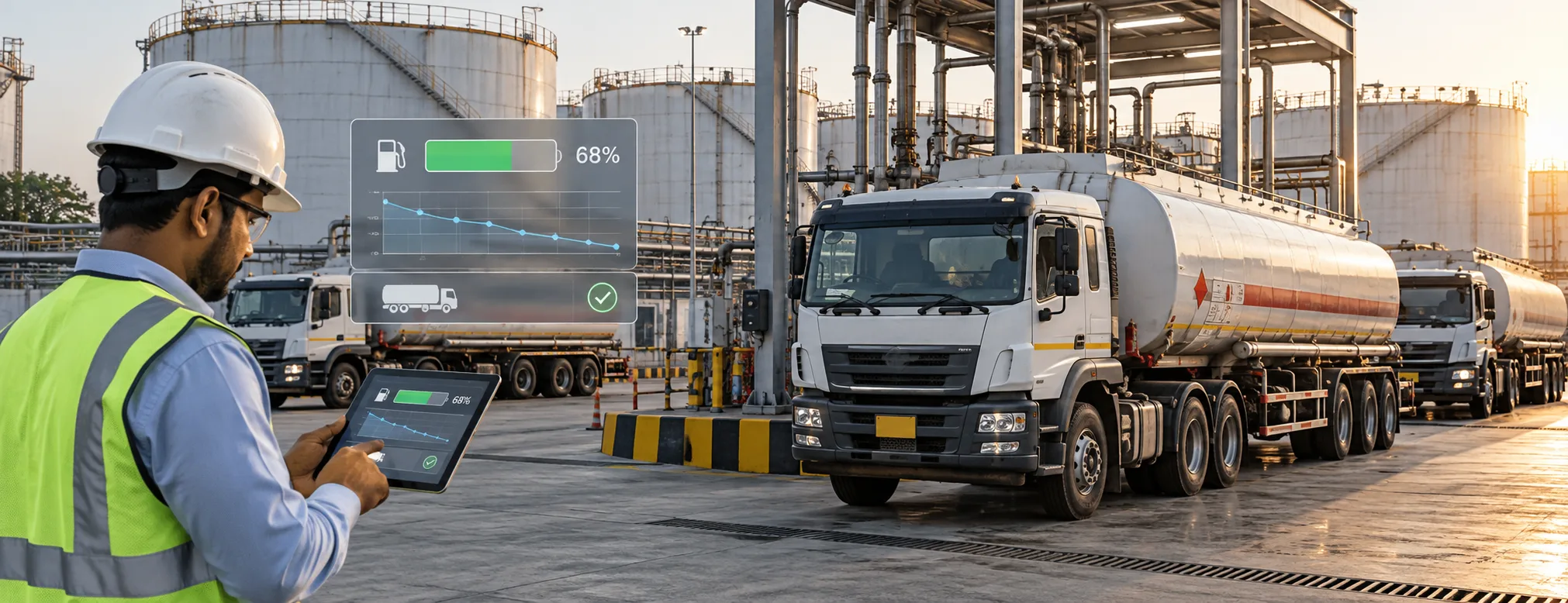
What Is Fuel Monitoring for Oil & Gas Fleets?
Fuel monitoring is the process of measuring, recording, and reviewing fuel activity across compatible vehicles, equipment, and other fuel-dependent assets.
Depending on the installed hardware and system configuration, fleet teams may be able to monitor:
- Current fuel level
- Historical fuel-level trends
- Fuel consumption
- Refuelling activity
- Significant fuel-level increases
- Unexpected fuel-level decreases
- Vehicle-specific fuel activity
- Event date and time
- Location context when GPS information is available
Fuel information may come from a compatible fuel level sensor, supported vehicle data, telematics equipment, or another approved data source.
The collected information can then be displayed through a centralized monitoring platform, helping managers review fuel activity across multiple vehicles or assets.
For broader fuel analysis, reporting, and operational management, explore the Diselmap Fuel Management System.
Why Fuel Visibility Matters in Oil & Gas Operations
Oil and gas businesses may operate very different types of vehicles and equipment.
These can include:
- Petroleum tankers
- Field-service vehicles
- Maintenance fleets
- Generators
- Heavy equipment
- Mobile machinery
- Remote operational assets
Fuel consumption can vary based on vehicle type, workload, route, operating hours, terrain, idling, equipment condition, and other operational factors.
Without structured fuel data, it can be difficult to understand whether changes in fuel usage are part of normal operations or require further review.
Connected fuel monitoring gives managers a clearer record of what happened over time instead of relying only on estimates or individual manual readings.
How Fuel Monitoring Works
A typical fuel-monitoring workflow can be understood in four simple stages.
1. Measure Fuel Data
A compatible sensor or supported vehicle-data source records selected fuel information.
Depending on the installation, this may include fuel level, fuel consumption, or other related measurements.
2. Transmit the Information
The recorded data is sent through a connected telematics or IoT device to the monitoring platform.
Data transmission may depend on the hardware, communication network, and operating environment.
3. Interpret Fuel Activity
The platform organizes incoming measurements into more useful information, such as:
- Current fuel level
- Historical fuel trends
- Refuelling events
- Consumption patterns
- Significant increases or decreases
4. Review Fuel Events
Fleet managers can review fuel information alongside available vehicle, trip, time, and location data.
This context is important because a fuel reading alone may not explain why a change occurred.
Key Fuel Events Fleet Managers Can Monitor
Fuel-Level Changes
Monitoring fuel levels over time gives fleet teams a clearer picture of how tank content changes during vehicle or equipment operation.
Historical readings are usually more useful than a single measurement because they make it easier to identify recurring patterns and significant changes.
Refuelling Activity
A noticeable increase in recorded tank level may correspond to a refuelling event.
Depending on system capabilities, fleet teams may be able to review:
- Vehicle or asset
- Date and time
- Fuel level before the event
- Recorded increase
- Location
- Subsequent fuel usage
The accuracy of the event depends on factors such as sensor type, tank design, calibration, installation, and system configuration.
Unexpected Fuel Drops
A significant decrease in fuel level may require further investigation.
However, an unexpected fuel drop should not automatically be treated as proof of fuel theft.
Changes in readings may also be influenced by:
- Normal fuel consumption
- Vehicle movement
- Fuel sloshing
- Tank geometry
- Sensor behaviour
- Calibration
- Leakage
- Operating conditions
Fleet teams should review the event together with historical and operational information before reaching a conclusion.
Fuel Consumption Trends
Historical fuel information can help managers compare consumption across:
- Vehicles
- Equipment
- Routes
- Operating periods
- Asset types
Recurring differences may help identify vehicles or equipment that require closer operational or maintenance review.
Fuel Monitoring Across Different Oil & Gas Assets
Fuel-monitoring requirements vary depending on the vehicle, equipment, and type of operation.
Petroleum Tankers
For petroleum tankers, it is important to distinguish between two different types of fuel:
Vehicle fuel is the diesel or other fuel used to operate the tanker truck itself.
Transported petroleum product is the cargo being carried inside the tanker body.
These are different measurement requirements and should not be treated as the same monitoring application.
A vehicle fuel-monitoring system may be used to review the truck’s operating fuel, while cargo measurement requires equipment and processes designed for the transported product and applicable operating requirements.
For tanker location, routes, trips, and vehicle movement, see the Oil Tanker Tracking System guide.
Field-Service Vehicles
Field-service vehicles may travel between depots, terminals, project locations, and remote operational sites.
Fuel monitoring can help fleet managers compare consumption and refuelling information with actual vehicle activity.
Heavy Equipment and Machinery
Heavy equipment may operate for long periods while travelling relatively short distances.
For these assets, operating hours and workload may sometimes provide more useful context than kilometres travelled when reviewing fuel consumption.
Generators and Remote Assets
Generators and other stationary or semi-mobile assets can be difficult to inspect frequently, especially in remote locations.
Compatible monitoring equipment can provide additional fuel visibility between physical inspections.
Benefits of Fuel Monitoring for Oil & Gas Fleets
Better Fuel Visibility
Fleet managers can review fuel activity across compatible vehicles and assets through a more structured data source.
Stronger Fuel Accountability
Vehicle-specific and asset-specific records make it easier to compare fuel additions, consumption, and significant changes over time.
Faster Review of Unusual Events
Significant fuel changes can be identified for investigation instead of being discovered only through manual checks or later reconciliation.
Better Consumption Analysis
Historical information helps managers compare operating patterns between similar vehicles, equipment, routes, or working periods.
Less Dependence on Manual Checks
Connected monitoring can reduce reliance on paper-based records and repeated physical tank readings.
Better Operational Context
When fuel information is combined with GPS, trip, or vehicle data, managers can better understand where and when a fuel event occurred.
Practical Example: Reviewing an Unexpected Fuel Drop
Consider a field-service vehicle travelling from a depot to a remote oil and gas site.
Normal Operation
The monitoring system records a gradual reduction in fuel level while the vehicle is operating.
Significant Change Detected
A larger-than-usual decrease appears in the historical fuel data.
Review the Context
Before reaching a conclusion, the fleet manager checks:
- Time of the event
- Vehicle location
- Trip history
- Previous fuel readings
- Readings after the event
- Vehicle activity
- Sensor behaviour
GPS information can be useful here because it may show where the vehicle was when the change occurred.
Investigate When Necessary
If the event remains unexplained after reviewing the available information, the fleet team can carry out further operational checks or physical inspection.
This approach is more reliable than treating every unusual reading as fuel theft or misuse.
Fuel Monitoring vs Fuel Management
Fuel monitoring and fuel management are closely related, but they have different roles.
| Fuel Monitoring | Fuel Management |
|---|---|
| Focuses on fuel-data visibility | Covers a broader fuel-management process |
| Monitors fuel levels | Combines monitoring, analysis, and reporting |
| Records selected fuel events | Supports fleet-wide fuel workflows |
| Shows consumption patterns | Helps teams compare and act on fuel information |
| Uses sensor or vehicle data | Uses fuel data within broader operational management |
A simple distinction is:
Fuel monitoring shows what is happening with fuel data.
Fuel management helps businesses use that information as part of a wider operational process.
This article focuses on fuel-monitoring technology and its practical application in oil and gas operations.
For product capabilities, fleet-wide reporting, and commercial implementation, visit the Diselmap Fuel Management System.
GPS Tracking vs Fuel Monitoring
GPS tracking and fuel monitoring answer different operational questions.
| GPS Tracking | Fuel Monitoring |
|---|---|
| Vehicle location | Fuel level |
| Route history | Consumption trends |
| Trips | Refuelling activity |
| Stops | Significant fuel changes |
| Geofence activity | Historical fuel records |
| Vehicle movement | Fuel-event information |
GPS tracking primarily answers:
Where is the vehicle and how is the trip progressing?
Fuel monitoring primarily answers:
What is happening with the vehicle’s fuel data?
When the two systems are connected, managers gain additional context.
For example, if a significant fuel-level change occurs, GPS data may help show the vehicle’s location and trip activity at that time.
Learn more about vehicle and trip visibility through Diselmap’s GPS Tracking System.
The Role of Fuel Level Sensors
The usefulness of fuel-monitoring data depends heavily on how the information is measured.
A compatible fuel level sensor can collect tank-level information and send readings to a connected monitoring platform.
However, several factors can affect fuel readings.
Tank Geometry
Irregular tank shapes can make the relationship between liquid height and actual fuel volume more complex.
Sensor Installation
Installation should be suitable for the vehicle, tank, and selected sensor technology.
Calibration
Proper calibration helps convert sensor measurements into more meaningful fuel-level information.
Vehicle Movement
Acceleration, braking, cornering, uneven roads, and equipment movement can cause fuel to move inside the tank.
Operating Conditions
Vibration, temperature, equipment use, and other environmental factors can influence some installations.
For hardware-specific information, see Diselmap’s Fuel Level Sensor.
Challenges and Limitations of Fuel Monitoring
Fuel-monitoring technology can provide useful information, but its limitations should also be understood.
Data Quality Depends on the Hardware
The accuracy and usefulness of data depend on suitable hardware, installation, configuration, and compatibility.
Calibration Matters
Incorrect calibration can lead to misleading fuel-level estimates.
Connectivity Can Vary
Vehicles or equipment operating in remote locations may experience delays in data transmission when communication coverage is limited.
One Reading Does Not Establish a Pattern
An isolated reading should usually be reviewed together with previous and subsequent measurements.
Features Depend on the Deployment
Not every vehicle or equipment configuration supports the same fuel-monitoring capabilities.
Fuel level, refuelling detection, consumption reporting, and abnormal-drop monitoring depend on the installed equipment and available data.
Businesses should confirm which capabilities are supported for their specific fleet.
How to Choose a Fuel Monitoring System for Oil & Gas Fleets
Choosing a suitable monitoring system should begin with the operating requirement rather than a long list of features.
Check Vehicle and Asset Compatibility
Confirm that the proposed hardware works with the vehicles, equipment, and tank types that need to be monitored.
Evaluate Installation Requirements
Ask how the sensor or monitoring equipment will be installed and protected in the operating environment.
Confirm Calibration
Understand how the system is calibrated for different tank shapes and capacities.
Review Historical Reporting
Managers should be able to review fuel trends over useful time periods rather than seeing only the current level.
Review Fuel-Event Information
Significant fuel increases and decreases should be easy to identify and investigate.
Consider GPS and Telematics Integration
Location and trip data can provide additional context around fuel events.
Look for Centralized Monitoring
Businesses operating multiple vehicles or assets benefit from reviewing fuel information through a common interface.
Evaluate Deployment and Support
Installation, configuration, calibration, onboarding, and technical assistance should all be considered when selecting a system.
Fuel Monitoring in Oil & Gas Operations in India
Fuel monitoring is an operational visibility tool. It does not replace legal, safety, transport, storage, or licensing requirements that may apply to petroleum operations.
In India, the Petroleum and Explosives Safety Organisation (PESO) administers regulatory responsibilities covering areas including petroleum storage and transportation.
Businesses involved in applicable petroleum operations can also refer to the official Petroleum Rules, 2002 for regulatory information.
The Oil Industry Safety Directorate (OISD) publishes safety standards and recommended practices for the oil and gas industry, including guidance relevant to petroleum transportation.
Requirements can vary depending on the petroleum product, vehicle, equipment, facility, and operating activity.
Businesses should therefore verify current requirements with the relevant authority for their specific operation rather than relying on a fleet-monitoring platform as evidence of compliance.
Frequently Asked Questions About Fuel Monitoring for Oil & Gas Fleets
What is fuel monitoring for oil and gas fleets?
Fuel monitoring uses compatible sensors, telematics, or supported vehicle data to help fleet teams review fuel levels, consumption patterns, refuelling activity, and selected fuel-level changes across vehicles or equipment.
Can fuel monitoring detect fuel theft?
Fuel monitoring can identify significant or unusual fuel-level changes that may require investigation. A sudden change alone should not be treated as proof of theft because vehicle movement, consumption, sensor behaviour, calibration, tank design, and other factors can influence readings.
Can a fuel monitoring system identify refuelling?
A compatible system may identify significant increases in recorded fuel level that correspond with refuelling activity. The accuracy of the event depends on the sensor, installation, calibration, tank design, and system configuration.
Can fuel monitoring work with GPS tracking?
Yes, when compatible systems are integrated. GPS tracking can provide vehicle location, trip, and route context around selected fuel events.
What is the difference between a fuel level sensor and a fuel management system?
A fuel level sensor is hardware used to collect tank-level information. A fuel management system uses fuel data within a broader platform for monitoring, reporting, analysis, and operational decision-making.
Can fuel monitoring be used for generators and remote equipment?
Selected generators, machinery, and other fuel-dependent assets can be monitored when suitable sensors, power, connectivity, and system compatibility are available.
Does fuel monitoring automatically reduce fuel costs?
No. Fuel monitoring provides information that can help managers identify patterns and make better-informed decisions. Actual cost outcomes depend on fleet operations, equipment condition, management practices, and how the information is used.
How Fuel Monitoring Fits into Oil & Gas Fleet Operations
Fuel monitoring is most useful when it becomes part of a wider operational workflow.
A business may combine fuel information with:
- GPS tracking
- Vehicle telematics
- Driver behaviour data
- Maintenance information
- Remote asset monitoring
- Operational reports
Each technology should have a clear purpose.
Fuel monitoring should focus on fuel activity and trends, while GPS tracking focuses on vehicle movement, and broader fleet-management systems bring multiple types of operational information together.
For the wider industry solution, explore Diselmap’s Oil & Gas Fleet Management Solutions.
Improve Fuel Visibility Across Your Oil & Gas Fleet
Diselmap helps businesses monitor fuel activity across compatible commercial vehicles and equipment using connected sensors, telematics, GPS tracking, and fleet technology.
Review fuel levels, consumption patterns, refuelling activity, and selected fuel events through a centralized platform configured around your operational requirements.